ΟΙ ΤΟΙΧΟΓΡΑΦΙΕΣ ΤΟΥ ΜΑΚΕΔΟΝΙΚΟΥ ΤΑΦΟΥ ΤΟΥ ΑΓ.ΑΘΑΝΑΣΙΟΥ
(τελευταίο τέταρτο του 4ου αι. π.χ.)
Η πρόσοψη του τάφου είναι κατάγραφη. Το τριγωνικό αέτωμα κοσμούν μυθικοί γρύπες με ολόχρυσα φτερά, ακολουθούν βαθυκύανα τρίγλυφα και λευκές μετόπες, ενώ στη στενή ζωφόρο επάνω από το θυραίο άνοιγμα ξετυλίγεται μια σκηνή συμποσίου, τόσο οικεία από διάφορες φιλολογικές μαρτυρίες ή την αγγειογραφία, αλλά για πρώτη φορά τόσο ζωντανά μπροστά στα μάτια των επισκεπτών.
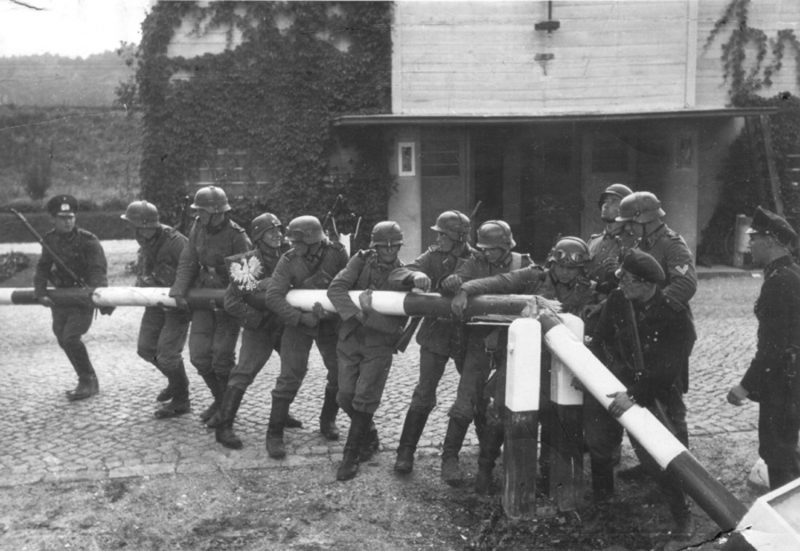
German
troops removing a gate at a border checkpoint, Zoppot-Gdingen
(Sopot-Gdynia) Street in Danzig (Gdańsk), 1st September 1939 (Wikipedia)
On
the 1st of September, 77 years ago, the horror World War II was
unleashed upon the world when the German Army invaded Poland. The
Invasion of Poland, also known as a September Campaign in Poland or Fall
Weiss (Case White) in Germany, was a joint attack by Nazi Germany, the
Free City of Danzig, the Soviet Union, and a small Slovak contingent.
On the eve of VJ Day and with Japan’s PM Shinzo Abe expressing
‘profound grief’ for WWII. We are going to look at just 10 Japanese
Atrocities From World War II by listverse.com
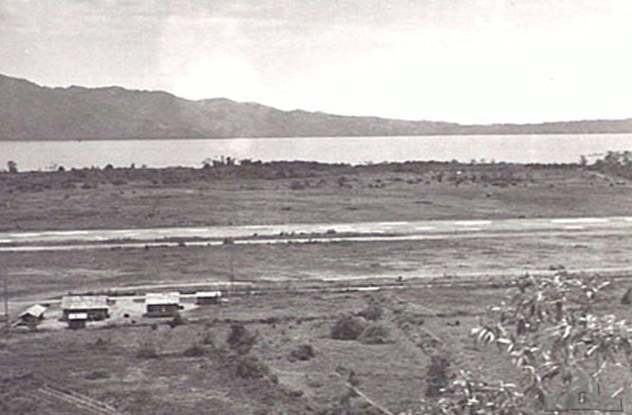
Laha Airfield Massacre
February 1942
This ghoulish event, which killed more than 300 Australian and Dutch POWs, followed the Japanese capture of the Indonesian island of Ambon. Allegedly as an act of reprisal
after the Allies destroyed one of their minesweepers, the Japanese
randomly selected prisoners and executed them via beheading and bayonet
near the island’s airfield. They then repeated the process three more
times during the month.
The magnitude of this atrocity was enough for an Australian military
tribunal to prosecute more than 90 Japanese officers and soldiers after
the war in one of the biggest war crime trials
in history. The tribunal sentenced four of the accused to death and
handed out a range of sentences for the others. Unfortunately, they
never got to try the mastermind, Rear Admiral Hatakeyama. The Japanese
officer died while awaiting his trial.
The battle of Varbitza Pass and the death of Byzantine Emperor Nikephoros.
There have been many Byzantine Emperors who had died in battle – Emperors Julian,
Valens and famously Constantine XI Palaiologos, the last emperor who
couldn’t hold back the might of the Ottomans in 1453. But not many are
familiar with the story relating to the death of Emperor Nikephoros and
the desecration of his dead body by the Khan of Bulgaria, Krum.
The official blog of the English Civil War re-enactment group! Visit our website at www.earlofmanchesters.co.uk
On 14th June 1645, the fields between the Northamptonshire
villages of Naseby and Sibbertoft saw one of the most significant
battles in British history. Royalist troops loyal to King Charles I and the
Parliamentarian ‘New Model Army’ led by Sir Thomas Fairfax met in the
culmination of a three-year bloody civil war that had pitted families
and friends against each other and the fates of England, Wales,
Scotland, and Ireland rested in the balance. So why is The Battle of Naseby so important in British history…?
There are acres and acres of writing about the most “pivotal” moments
in history, those occasions when the future seems to turn on a single
act and everything after it owes its existence that that moment.
In lists of British history, the Battle of Naseby is one such moment.
Read this fascinating tale of state power over
commonsense military design. Stalin wanted a land battleship, and he was
going to get one no matter how
impractical it was.
Since the collapse of the Soviet Union, new facts have surfaced about the secret weapons developed by the Red Army during WWII.
Detail of a Hadith referring to the succession of the Twelve Imams, at
the shrine of Sayyida Ruqayya, Damascus; from People of the Prophet’s
House edited by Fahmida Suleman (275pp. Azimuth. £35. 978 1 898592 32 7)
THOMAS SMALL
This piece forms part of a TLS Special Feature, our primer on the complex politics and religions of the Middle East
A hadith (or saying of the Prophet Muhammad)
considered sound by all major authorities and widely circulated among
Sunni Islamists states that the history of the umma will go
through five phases: first, the Prophet himself will rule over it and
teach it the right way to live; then will come the time of caliphate,
when caliphs will rule according to the Prophet’s teachings; then the
time of benign kingship obtained by force, followed by the time of
oppressive kingship; finally, the time of caliphate will rise again,
where a caliph will rule once more in accordance with the Prophet’s
teachings, and usher in the end of the world.
From this eschatological perspective, Ataturk’s abolition of the
Ottoman Caliphate in 1923 marked the end of the third of those five
phases, the phase of benign kingship. Since then, the Islamic world has
been suffering the injustice of oppressive kingship, whether at the
hands of brutal dictators or morally bankrupt monarchs. And though
jihadist groups differ over the best way to achieve it, they are united
by an ultimate aim, which they share, broadly speaking, with all forms
of Islamism: the restoration of the Caliphate as a necessary step along
the way to the Last Judgement.
On
October 29, 1945, the Allied Control Council in Germany issued a decree
dissolving the organizations of the National Socialist Party including
its leading press agency and publishing house, the Franz Eher Nachfolger
GmbH. Since the headquarters of the firm was in Munich, the property of
the Eher Verlag was transferred to the Free State of Bavaria, which
also assumed legal succession and trusteeship of its assets. A
provisional court in Munich (Spruchkammer) initiated criminal
proceedings against Max Amann, who had amassed a considerable fortune as
the head of Nazi Germany’s largest publishing enterprise, sentencing
him to ten years imprisonment. In 1948, all copyrights were transferred
to the Bavarian State Ministry of Finance, including the copyright to Mein Kampf,
which belonged to the literary estate of Adolf Hitler. Since German
copyright law stipulates that all rights revert to the public domain
seventy years after the death of the author, the copyright to Mein Kampf expired on December 31, 2015. Mein Kampf
was never actually banned in the Federal Republic of Germany; it was
sold in second-hand bookshops, was obtainable in libraries, and in
recent years has been readily available on the internet. Only the
publication of the book was proscribed.
Underwater photos by Tomasz “Tomek” Stachura
Graf
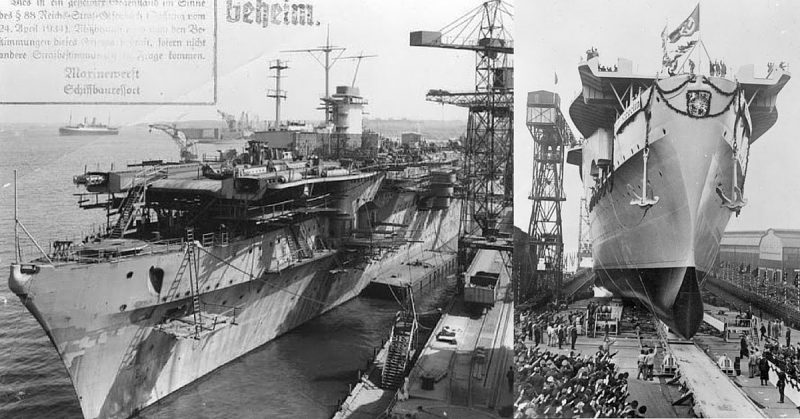
Zeppelin (Flugzeugträger A, Aircraft Carrier A) was the only aircraft
carrier launched by Germany during World War II. It represented part of
the Kriegsmarine’s attempt to create a well-balanced oceangoing fleet,
capable of projecting German naval power far beyond the narrow confines
of the Baltic and North Seas.
A diving team from Poland, including
experienced scuba divers Dimitris “Dima” Stavrakakis and acclaimed
underwater photographer Tomasz “Tomek” Stachura share with
pierrekosmidis.blogspot.com their experience and stunning underwater
photos of a unique WW2 Wreck, the only German aircraft carrier that was
never meant to see active duty.
Stavrakakis says:
“The
diving expedition was well prepared and planned, since we were the
first scuba divers to visit the shipwreck, with special permission from
the authorities.
“We had two doctors and a hyberbaric chamber on
board, because of the demanding nature of those dives at depths ranging
from 75 to 95 metres.
By Pierre Kosmidis / pierrekosmidis.blogspot.gr
A
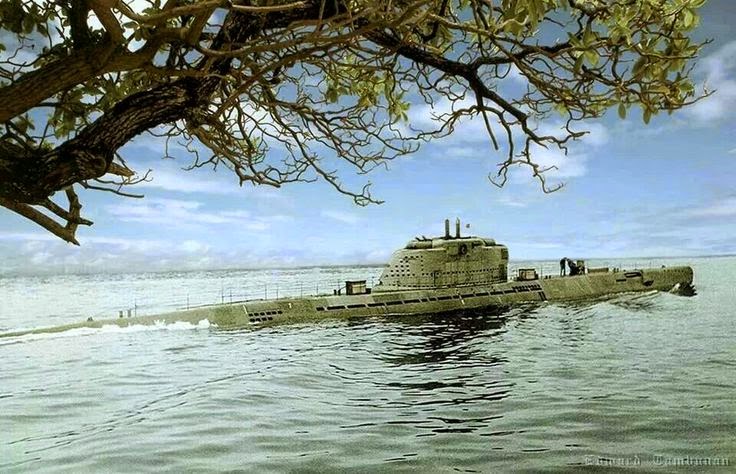
Second World War mega-submarine of Imperial Japanese Army had been
successfully mapped and filmed, a year and half after it was first
discovered off the coast of Hawaii.
Decades
ahead of its time, the I-400 submarine was among the largest and
technologically most advanced submarines of its era. The aircraft hangar
of the submarine was large enough to facilitate the launch of at least
three float-plane bombers.
To gain an edge here on Earth, China is pushing ahead in space
By Clay Dillow, Jeffrey Lin, and P.W. Singer
September 20, 2016
Before
this decade is out, humanity will go where it’s never gone before: the
far side of the moon. This dark side—forever facing away from us—has
long been a mystery. No human-made object has ever touched its surface.
The mission will be a marvel of engineering. It will involve a rocket
that weighs hundreds of tons (traveling almost 250,000 miles), a robot
lander, and an unmanned lunar rover that will use sensors, cameras, and
an infrared spectrometer to uncover billion-year-old secrets from the
soil. The mission also might scout the moon’s supply of helium-3—a
promising material for fusion energy. And the nation planting its starry
flag on this historic trip will be the People’s Republic of China.
After years of investment and strategy, China is well on its way to
becoming a space superpower—and maybe even a dominant one. The Chang’e 4
lunar mission is just one example of its scope and ambition for turning
space into an important civilian and military domain. Now, satellites
guide Chinese aircraft, missiles, and drones, while watching over crop
yields and foreign military bases. The growing number of missions
involving Chinese rockets and taikonauts are a source of immense
national pride.
“China sees space capability as an indication of global-leadership
status,” says John Logsdon, founder of the Space Policy Institute at
George Washington University. “It gives China legitimacy in an area that
is associated with great power.”
Here
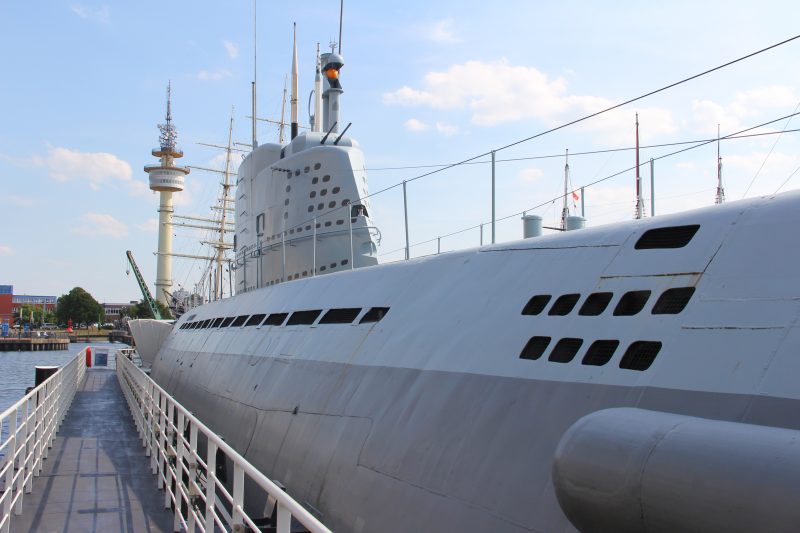
she is in all her glory. Type XII introduced streamlining in U-Boat
design, resulting in a quantum leap in underwater performance. All
submarines before this one were basically designed to submerge and stay
under the surface in one place (sans minor pedestrian manoeuvres using
electric power). Type XXI could easily steam in circles around any
Allied convoy – all under water. sourceU-2540
was an advanced submarine which entered service on 24th February 1945.
Less than 3 months later, on 4th May, she was scuttled by her own crew.
In
1957, she was raised and returned to service on 1st September 1960 as
the research submarine Wilhelm Bauer. She served in a civilian role
under various research projects before decommissioning on 15th March
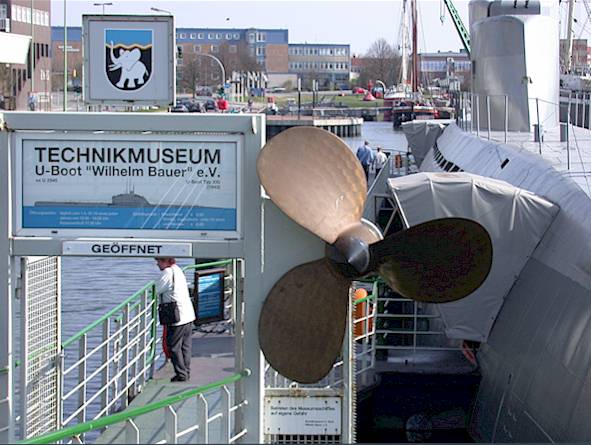
1982. On 24th April 1984, she was transferred to the Deutsches
Schiffahrtsmuseum (German Maritime Museum) as the Technikmuseum Wilhelm
Bauer.
The
entrance to the museum is adorned by two propellers, one of which is
shown here. I’m quite certain that these are the original propellers of
this U-boat. sourceIn
the spring of 1943, Germany was clearly losing the battle of the
Atlantic. Improvements in Allied escort material and tactics, combined
with cracking the German military code dramatically increased the
U-Boats´ losses, rendering them near useless. The German high command
saw its best reaction in the speedy development of improved submarines.
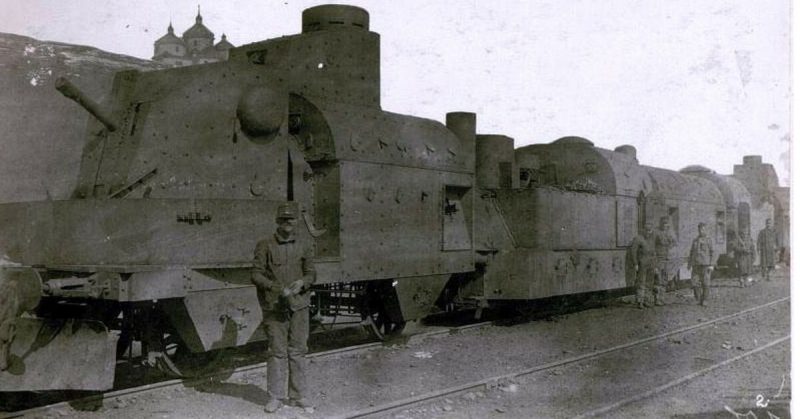
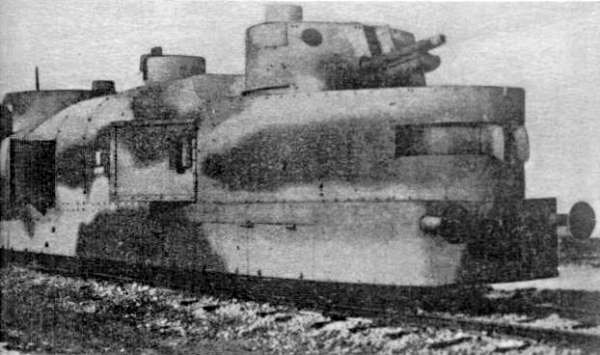
Autro-Hungarian armored train, 1915. Wikipedia, Public Domain,
Armored
trains are a relic of the past by today’s standards but in the late
19th and early 20th century, these big steel-plated locomotives besieged
cities, pierced frontlines and supported infantry attacks all over the
world.
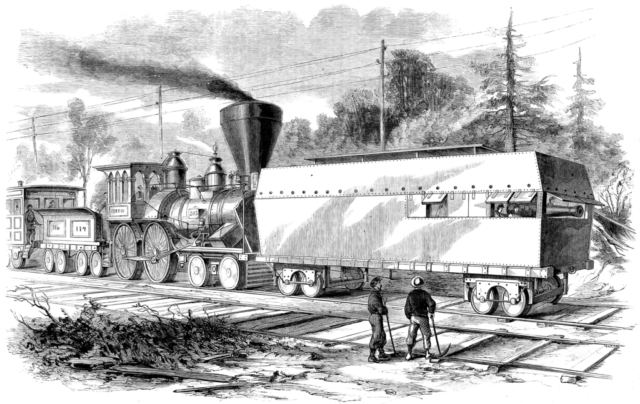
The beasts of the railroads began their epic service in the
American Civil War when a single car was built to defend the
Philadelphia, Wilmington and Baltimore Railroad. Then war trains saw
action in the Franco-Prussian War of 1870, and the First and the Second
Boer Wars which led the machines into the 20th century.
An 1861″Railroad
battery” used to protect workers during the American Civil War. By
Sketch by William C. Russell, engraver unknown, for Frank Leslie’s
Illustrated Newspaper – Frank Leslie’s Illustrated Newspaper. Page 9,
May 18, 1861, No. 287–Vol. XII. From digital scan at
http://archive.org/details/franklesliesilluv1112lesl, Public Domain,
https://commons.wikimedia.org/w/index.php?curid=20572199In
1905, these trains were used in the Far East as part of the
Russo-Japanese War, where the advantage of a large armored vehicle on
rails during harsh winters proved to be irreplaceable. Russia later saw
the even more extensive use of armored trains during the First World War
and the Civil War which commenced immediately after the October
Revolution.
Trains
were seen as transport mainly at the time, as they were capable of
carrying a large number of people and equipment in a short period of
time. Its transport use revolutionized the way battlefield logistics
were executed at the time. The fact that the machine was tied to the
tracks didn’t represent such a disadvantage, for this was the only dawn
of the automobile age and the four-wheelers were still lagging behind
the locomotive.
Needless to say, tanks were only in development
during the First World War, so flawed designs often lost sympathy in the
military, and trains proved to be more reliable. Mounted with cannons
and encased with thick armor, the trains were fearsome fighting
machines.
A typical Polish artillery car from 1939. Public Domain, https://commons.wikimedia.org/w/index.php?curid=89125But
trains are perceived as transport mainly today, so this appendix of
history takes place in a time before the rapid development of armored
vehicles in the interwar period. During the Mexican Revolution
(1910–1920), the Spanish Civil War (1936-1939) and the Second World War
armored trains were actively used by all parties included in the
conflicts.
In Poland, trains were active in the defense effort of
the September campaign against the invading Germans. The Germans, on the
other hand, developed super cannons on a train chassis, most famous
being the Schwerer Gustav, which saw limited service, but had a
devastating effect during the siege of Sevastopol.
Apart from
official military use, trains often served as support for partisan
groups which staged massive offensives during the last years of the
Second World War. Such was the case in Slovakia, where three armored
trains ― The Hurban, Štefánik, and Masaryk ― delivered a decisive blow
to the weakened German units in September of 1944.
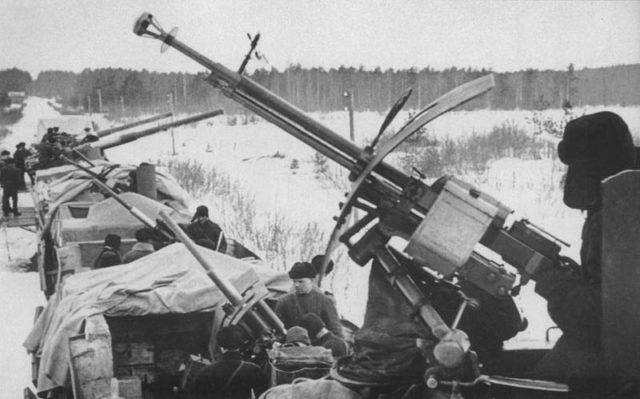
A Russian WW II-era armored
train with antiaircraft gunners. By Unknown –
http://mechcorps.rkka.ru/files/bepo/media/bepo_094.jpg, Public Domain,
https://commons.wikimedia.org/w/index.php?curid=5150971The
reason for its abandonment was clearly the change within the methods of
warfare, as tanks and motorized infantry dictated military doctrines
that slowly pushed out the armored train. Since trains were limited to
railroads, they were more vulnerable to bombers and artillery.
In
addition to that, the railways were more and more subjected to acts of
sabotage by commando or partisan units, which slowed the advance of the
trains significantly. The mere fact that it relied on the use of tracks
turned these war machines into vulnerable giants.
Nevertheless, trains continued to serve in battle even after WWII (but far less actively), most notably in Indochina.
But
in the countries of the Eastern Bloc, the use of trains as means of
battle was nurtured as a tradition. Even though it was old-fashioned in a
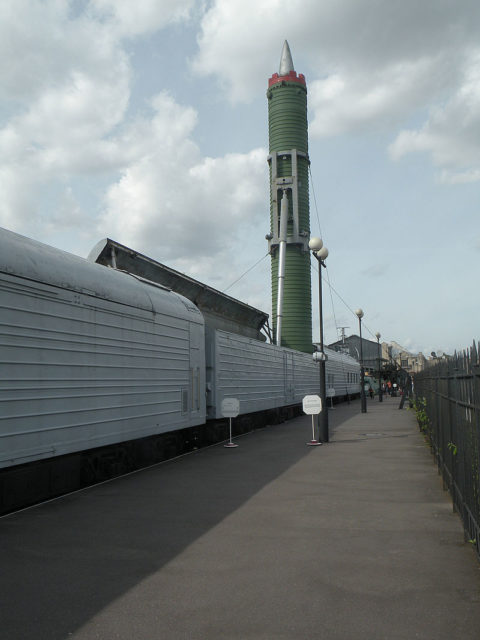
way, it was still suitable for serving as a mobile intercontinental ballistic missile (ICBM)
launching ramp. In the late stages of the Cold War, the RT-23 Molodets,
an intercontinental ballistic missile, entered service in the Soviet
Union during the Cold War.
Rt
23 complex “Molodets” as a cargo train with a sensor for orientation on
the lighting mast. By Vitold Muratov – Own Work, CC BY-SA 3.0,
https://commons.wikimedia.org/w/index.php?curid=27780149It
was capable of carrying a nuclear warhead. One of the options for
transporting and launching the missile was from a specially designed
train across the Trans-Siberian Railway. The strategic importance of
this railway was emphasized during the 1970s after the split between the
Soviet and the Chinese government. According to different accounts,
four or five armored trains were built in order to protect the
southeastern borders of USSR.
Every train included ten main battle
tanks, two light amphibious tanks, several AA guns, as well as several
armored personnel carriers, supply vehicles and equipment for railway
repairs. They were all mounted on open platforms or in special rail
cars. Different parts of the train were protected with 5–20mm-thick
armor.
So it is not surprising that some of the last known uses of
armored trains happened during the conflicts following the collapse of
the Soviet Union 1990s, most notably in the disputed area of
Nagorno-Karabakh, between today’s Armenia and Azerbaijan.
Also,
during the Yugoslav Wars from 1991 to 2001, some improvised armored
trains were used by paramilitaries in the conflict in Croatia and
Bosnia. These were regular passenger trains transformed into terrible
land cruisers, capable of laying siege to towns and villages across the
war-torn Bosnia.
The
most infamous train that was in service during those years was the
Krajina Ekspres, employed by the members of a Serbian paramilitary in
Bosnia. The train took part in a three-year-long siege of the town of
Bihac, which lasted from 1992 to 1995.
Even then the technology
was considered to be obsolete, but in a conflict between various
paramilitary and guerilla groups, such hardware proved to be
intimidating. In late 2015, Pro-Russian militants in the Donbass region
of Ukraine were pictured operating a homemade armored train.
One
armored train that remains in regular use is that of Kim Il-sung and Kim
Jong-il, which the former received as a gift from the Soviet Union and
the latter used heavily for state visits to China and Russia as he had a
fear of flying.
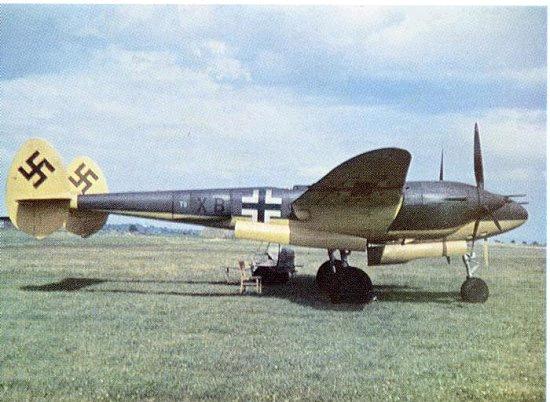
Ever
wondered what happened with the airplanes that made an emergency
landing in occupied territory? When captured (relatively) intact they
were tested by the Germans and sometimes put into service!
Enjoy these amazing pictures of familiar Allied airplanes in very unfamiliar colors and markings!
The waters off the coast of Antikythera in Greece hold many
mysteries of the ancient world that are yet to be uncovered. Site of the
largest shipwreck from antiquity, the region boasts a treasure trove of
invaluable artifacts as well as the famous Antikythera Mechanism, a
2,000-year-old astronomical calculator that is widely considered the
world’s oldest computer. Recently, researchers working at the site have
discovered a well-preserved skeleton of a young man, which they believe
could provide the earliest DNA evidence ever retrieved from a sunken
vessel.
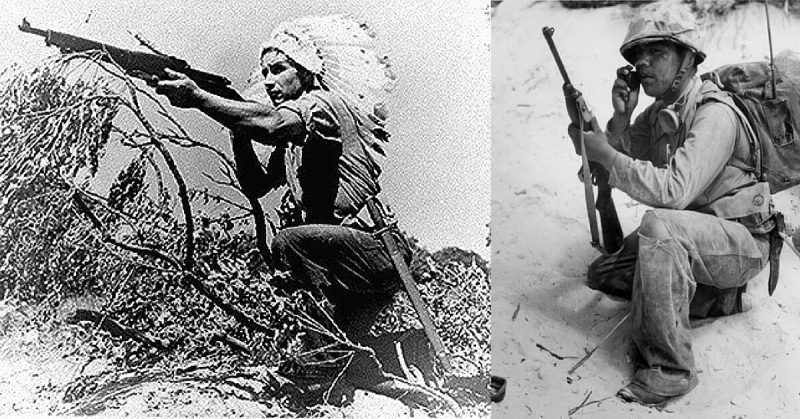
Native
Americans made an enormous contribution to the World War II effort.
Sadly, their involvement in the conflict is widely overlooked.
Sometimes, they are portrayed as codebreakers and nothing more. This is
not the case. Native Americans played a huge role in the war from its
beginning to its end.
From the time the Europeans began settling
in the New World, the population of the Native Americans began
decreasing at an alarmingly rapid rate. The group’s population was
seeing a little bit of a rise during the beginning of the 21st century.
However, another large chunk of this growing population would fall prey
to another harsh crime of the Western world – World War II. In fact,
44,000 Native American individuals participated in the war.
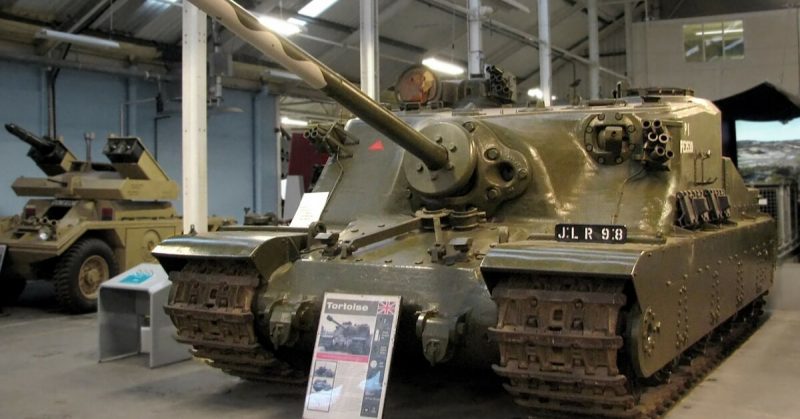
The
Heavy Assault Tank or Assault Gun, Tortoise, was a British tank design
developed in World War II but never put into mass production. It was
developed for the task of clearing heavily fortified areas and as a
result favoured armour protection over mobility.
In the early part
of 1943, the Allied forces anticipated considerable resistance in the
projected future invasion of Europe, with the enemy fighting from
heavily fortified positions such as the Siegfried Line. As a result, a
new class of vehicles emerged, in the shape of Assault tanks, which
placed maximum armour protection at a higher priority than mobility.
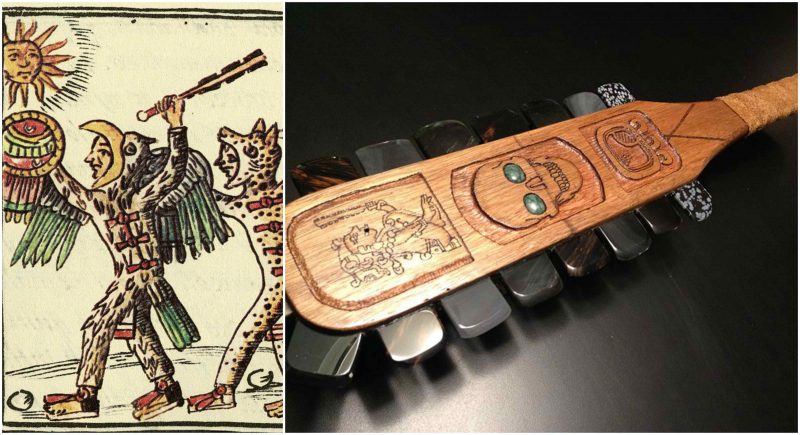
A macuahuitl, a
type of macana, is a wooden sword with obsidian blades. The name is
derived from the Nahuatl language. Its sides are embedded with prismatic
blades traditionally made from obsidian, famous for producing an edge
far sharper than even high-quality steel razor blades. It was a common
weapon used by the Aztec military forces and other cultures of central
Mexico. It was described during the 16th-century Spanish conquest of the
region.
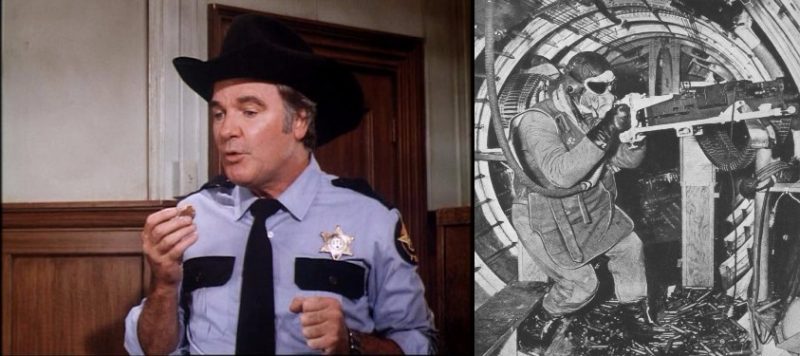
He
joined the Army Air Force in 1945 and was qualified as a B-17 “Flying
Fortress” Radio Operator/Aerial Gunner, serving in Europe at the end of
WWII. He was awarded the American Campaign Medal, WWII Victory Medal and
German Occupation Medal. James Best (born Jewel Franklin Guy;
July 26, 1926 – April 6, 2015) was an American actor, who in six
decades of television is best known for his starring role as bumbling
Sheriff Rosco P. Coltrane in the CBS television series The Dukes of Hazzard. He also worked as an acting coach, artist, college professor, and musician.