Credit: Amir Gorzalczany, Israel Antiquities Authority.
The unique legacy left behind by late Marcel Mazliah is something
to boast about when it comes to a historical scope. Over the years, the
electric company worker had made a personal collection of priceless
artifacts (with one of the items being around 3,500-years old) that were
salvaged from the Mediterranean Sea bordering Israel. And fortuitously,
his family has now decided to hand over the incredible treasure trove
to the Israel Antiquities Authority (IAA), which would earn them a good
citizen award from the state. But beyond ownership and recognition, one
particular artifact from the collection stands out – and it entails an
actual Crusader-era hand grenade that rather showcases its medieval
brand of fine craftsmanship.
From the perspective of etymology, the term ‘grenade’ was most
probably derived from Old French ‘pomegranate’ (possibly influenced by Spanish
granada)
circa 1590 AD, since the fruit resembles the fragmented-form of the
weapon. As for the historical side of affairs, grenades in their
rudimentary designs were probably used in the 8th century AD Eastern
Roman armies, with Greek Fire concoctions sometimes being stashed inside
pots and jars, to be thrown at enemies.

Credit: Diego Barkan, Israel Antiquities Authority
Greek Fire
in itself is said to be originally created by a Syrian Engineer named
Callinicus (who was a refugee from Maalbek). The technology was sort of a
precursor to napalm, and it entailed vicious ‘liquid fire’ that
continued to burn even while floating in water. In fact, some writers
have gone on to explain how the viciously efficient Greek Fire could
only be mitigated by extinguishing it with sand, strong vinegar or old
urine.
As for the hand grenade in question here, the embellished metal-made
bomb-like item probably harks back to the period circa 13th century AD,
thus coinciding with the time-frame of the Crusaders, Ayyubids and early
Mamluks. The military forces of this time possibly used some variation
of an inflammable substance, including a combination of materials like
naphtha, pitch (obtained from coal tar), sulfur and resin – for their
grenades. On the other hand, a few scholars believe that as opposed to
chemical warfare, these ‘grenades’ only had ornamental purposes for
storing perfume.

Credit: Diego Barkan, Israel Antiquities Authority.
In any case, archaeologists from the IAA were pleasantly surprised by
a slew of other metal objects that were stashed by Mazliah. According
to his family, the electric company worker got hold of the artifacts
from under the sea, as a result of numerous ancient and medieval
shipwrecks that dot the Israeli coast. Ayala Lester, a curator with the
IAA, stated –
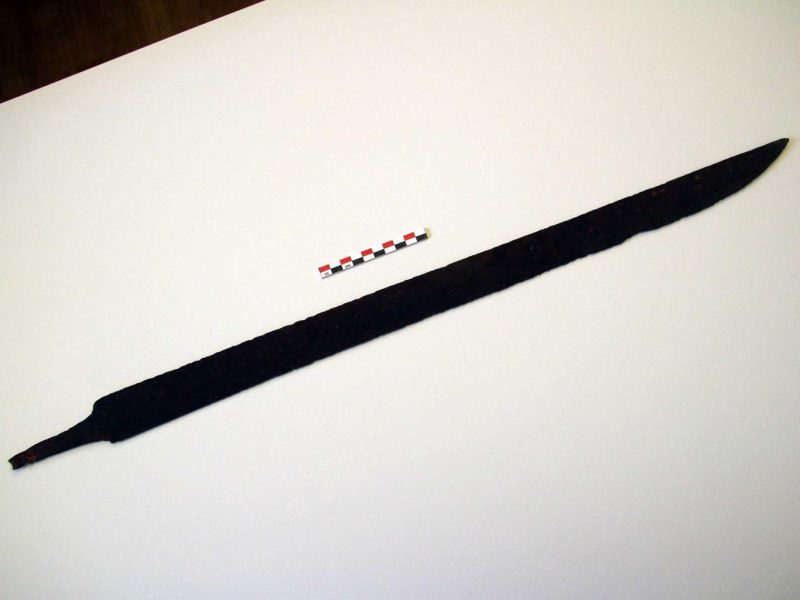
The finds include a toggle pin and the head of a knife
from the Middle Bronze Age from more than 3,500 years ago [see above].
The other items, among them, two mortars and two pestles, fragments of
candlesticks, and so on, date to the Fatimid period. The items were
apparently manufactured in Syria and were brought to Israel.
Lastly beyond the scope of the treasure trove accumulated by Mazliah,
the occurrence of shipwrecks around the coastal regions of Levant could
be attested by a fascinating find in May of this year. Touted to be the
largest hoard of marine-based objects
in the last 30 years in Israel, IAA announced that the treasure stash
contained both bronze statues and coins, along with other assorted
stuff. And interestingly enough, the discovery was made quite by chance
when two divers identified the remains of the ancient ship and reported
back to the authorities.

Credit: Amir Gorzalczany, Israel Antiquities Authority.