Επιστρέφουμε
σε εποχές φεουδαρχίας; Επιφανής οικονομολόγος κρούει τον κώδωνα του
κινδύνου θεωρώντας την εντεινόμενη κοινωνική ανισότητα τη μεγαλύτερη
πρόκληση για τις κοινωνίες της Δύσης. Οι ΗΠΑ το πιο ακραίο παράδειγμα.
Κινδυνεύει
η δημοκρατία από μια πλούσια ανώτερη κοινωνική τάξη; Το ερώτημα δεν
είναι νέο, εντούτοις επανήλθε με δριμύτητα στο προσκήνιο τα τελευταία
χρόνια ενόσω ο Λευκός Οίκος διοικούνταν από έναν δισεκατομμυριούχο
Τραμπ, που στηρίχθηκε μάλιστα προεκλογικά από εξίσου πάμπλουτους,
υπερσυντηρητικούς επιχειρηματίες. Όπως εκτιμούν ειδικοί, η εντεινόμενη
ανισότητα που παρατηρείται σε όλο και περισσότερες κοινωνίες χωρών της
Δύσης, θέτει τη δημοκρατία εν γένει σε κίνδυνο και τροφοδοτεί λαϊκιστικά
κινήματα.
Στις
ΗΠΑ η τάση αυτή φαίνεται μάλιστα να εδραιώνεται. Ο σερβοαμερικανός
οικονομολόγος Μπράνκο Μιλάνοβιτς διακρίνει ήδη πρώτες εκφάνσεις
«πλουτοκρατίας» η οποία θα μπορούσε να εξαλείψει τον φιλελεύθερο
καπιταλισμό και τη δημοκρατία. Όλα αυτά δεν αποκλείεται να οδηγήσουν σε
ένα σύστημα που θα είχε αρκετές ομοιότητες με τον κινεζικό καπιταλισμό.
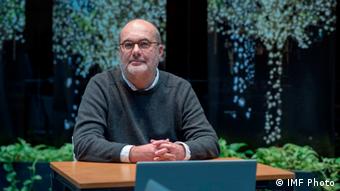
Ο σερβοαμερικανός οικονομολόγος Μπράνκο Μιλάνοβιτς
Ο
Μιλάνοβιτς θεωρείται ένας από τους εγκυρότερους μελετητές του
φαινομένου της οικονομικής ανισότητας. Το ζήτημα κυριαρχεί θεματικά και
στο νέο του βιβλίο που κυκλοφόρησε στα ελληνικά με τίτλο «Παγκόσμια
ανισότητα». Προ ετών ο σερβοαμερικανός ειδήμονας είχε προκαλέσει
ιδιαίτερη αίσθηση με το «γράφημα του ελέφαντα» που περιέλαβε σε έκθεσή
του για την Παγκόσμια Τράπεζα. Σε αυτό αποτυπωνόταν η εξέλιξη των
εισοδημάτων από τη δεκαετία του 1980. Σε χώρες όπως την Κίνα και την
Ινδία η μεσαία τάξη ωφελήθηκε σημαντικά. Το ίδιο ίσχυε για τη μικρή,
αλλά πανίσχυρη οικονομικά ανώτερη κοινωνική τάξη των βιομηχανικών χωρών.
Αντιθέτως, στα μεσαία και κατώτερα κοινωνικά στρώματα των χωρών αυτών
τα εισοδήματα είτε πάγωναν είτε και μειώνονταν.
Μνήμες φεουδαρχίας
Η
οργή πολλών οπαδών του Τραμπ και άλλων αγανακτισμένων σε άλλες δυτικές
κοινωνίες έχει λοιπόν μια πραγματική βάση. Ο βασικός λόγος έξαρσης του
φαινομένου είναι η εντεινόμενη απόκλιση μεταξύ εισοδημάτων και
κεφαλαιακών κερδών. Με απλά λόγια: όποιος διαθέτει μετοχές και ακίνητα
κατάφερε, στις περισσότερες περιπτώσεις, να πολλαπλασιάσει τις
τελευταίες δεκαετίες τα περιουσιακά του στοιχεία. Αντιθέτως, για όσους
είχαν τον μισθό τους ως μοναδική πηγή εσόδων, οι προοπτικές βελτίωσης
της προσωπικής οικονομικής τους κατάστασης είναι εξαιρετικά
περιορισμένες αν όχι μηδαμινές. Το αποτέλεσμα είναι στις ΗΠΑ (που
αποτελεί ακραίο παράδειγμα) το 90% των χρηµατοπιστωτικών περιουσιακών
στοιχείων να βρίσκεται στα χέρια ενός προνομιούχου 10% των πολιτών.
Θεωρητικά όλοι έχουν τη δυνατότητα ανέλιξης μέσα από ένα πολύ υψηλό
εισόδημα. Στην πράξη όμως πρόκειται ουσιαστικά για μια κλειστή κοινωνία.
Στη
βάση πολυάριθμων δεδομένων ο Μιλάνοβιτς σκιαγραφεί την εδραίωση μιας
ανώτερης τάξης που θυμίζει παλιές εποχές φεουδαρχίας. Διότι το πιο
συγκλονιστικό είναι ότι ο πλούτος και η φτώχεια, τρόπον τινά,
κληροδοτούνται στις επόμενες γενιές. Μεταξύ των διαφορετικών κοινωνικών
στρωμάτων υπάρχουν όλο και λιγότερα σημεία επαφής. Με αιχμή τον πλούτο
τους οι έχοντες διασφαλίζουν τα καλύτερα σχολεία και πανεπιστήμια, που
με τη σειρά τους διασφαλίζουν στους αποφοίτους τους υψηλότερα
εισοδήματα. Αξιοσημείωτο είναι ότι στις ΗΠΑ τα παιδιά από πολύ πλούσιες
οικογένειες έχουν 60 φορές περισσότερες πιθανότητες να σπουδάσουν σε ένα
καλό πανεπιστήμιο από τα παιδιά μεσαίων ή κατώτερων στρωμάτων.
Προτάσεις για έναν «λαϊκό καπιταλισμό»
Ο
Μιλάνοβιτς διακρίνει ήδη πρώτες εκφάνσεις «πλουτοκρατίας» η οποία θα
μπορούσε να εξαλείψει τον φιλελεύθερο καπιταλισμό και τη δημοκρατία
Την
ίδια ώρα και αξιοποιώντας το ιδιαίτερα αμφιλεγόμενο σύστημα σχεδόν
απεριόριστων προεκλογικών δωρεών στις ΗΠΑ, οι πλούσιοι διασφαλίζουν και
την επιρροή τους στην πολιτική. Πολλάκις έχει αποδειχθεί ότι το Κογκρέσο
ασχολείται και ψηφίζει συχνότερα για θέματα που αφορούν τους πλούσιους
και λιγότερο για εκείνα που απασχολούν τους λιγότερο προνομιούχους. Η
«φιλελεύθερη καπιταλιστική αξιοκρατία» όπως την έχει ονομάσει ο
Μιλάνοβιτς -αναπόσπαστο κομμάτι της οποίας αποτελούν το κράτος δικαίου
και η συμμετοχή των πολιτών- εισέρχεται με τον τρόπο αυτό σε ένα
επικίνδυνο μονοπάτι που ενδέχεται να οδηγήσει εν τέλει και στην
κατάργησή της.
Τι
πρέπει λοιπόν να γίνει; Ο οικονομολόγος κάνει λόγο για ένα είδος
«λαϊκού καπιταλισμού» ή «ισότιμου καπιταλισμού»: αφενός θα πρέπει να
επιβληθούν υψηλότεροι φόροι κληρονομιάς προκειμένου να ανακοπεί η
περαιτέρω συγκέντρωση κεφαλαίων και αφετέρου θα πρέπει να υπάρχει ένα
ισχυρό κοινωνικό κράτος με ένα καλό σύστημα δημόσιας εκπαίδευσης και
υγειονομικής περίθαλψης, που θα μπορούσε να λειτουργήσει ως τροχοπέδη
στο υφιστάμενο σύστημα δυο ταχυτήτων. Προτείνει επίσης την αυστηροποίηση
και ρύθμιση του συστήματος ιδιωτικών δωρεών στο πλαίσιο του
αμερικανικού προεκλογικού αγώνα προκειμένου να μετριαστεί η επιρροή των
πλουσίων στην πολιτική. Όπως επισημαίνει ο ειδικός, η ιστορία δείχνει
ότι χωρίς αυτές τις παρεμβάσεις η διόρθωση ακραίων ανισοτήτων γίνεται
συνήθως μέσα από «πολέμους, επαναστάσεις και σε ορισμένες περιπτώσεις
μέσα από έναν απροσδόκητο υπερπληθωρισμό».
(B) Democracy in decline and its fate after the crisis: Economic waves and democratic procedures
By Vasily Koltashov
An economist and historian specializing in economic crises from
ancient times to the epochs of commercial and modern industrial
capitalism. Head of the Institute of a New Society, Lecturer at the
Plekhanov Russian University of Economics. In early 2008, he gave a
surprisingly accurate analysis of the current crisis, a long-term
painful fracture, a major crisis transforming the world economy and the
life of society. The forecast of changes caused by the crisis continues
to be realised, confirming the theory of cyclicality of big crises.
Koltashov headed the drafting of numerous analytical reports. In his
book The Crisis of the Global Economy (2009), he spoke about the logic
of the first wave of global instability, warning that the crisis will
return. In 2013, at the beginning of the second wave of the crisis, the
author returned to Russia after six years of analysing the economic
catastrophe in Greece. In the same period, he began to study the
connection between major crises and the great modernisation revolutions
of the era of capitalism. Thus, for the first time, an economic and
socio-political analysis of such phases as the restoration and glorious
revolution was carried out.
In the 21st century one could observe the rise of democracy. In the
20th century for a long time it also seemed that democracy was
developing steadily moving from the formal to the real. However, the big
crisis of 1973-1982 led to a historic turn in its fate. Everything
turned out to be more complicated than previously thought.
A brief pedigree of democracy
The emergence of democracy was associated with the development of the
Greek polis economy. This happened after the “dark ages” that followed
the great economic crisis of the 12th century BC. The old economic
system collapsed whereas the new system had not formed yet. It took
several centuries of decline and degradation for it to occur. Another
great crisis in the 3rd century dealt a severe blow to the
municipalities of the Roman Empire with their democratic practices
stemming from earlier city states. In history the great and big economic
crises (they appeared after the great crisis of the 14th century) had a
huge impact on social structures and relations, which are usually
associated with the concept of “democracy”. The era after World War II
is no exception. From that time to the present, democracy as a form of
power and organisation of social structures has undergone enormous
changes.
The concept of “democracy” is used widely, but is very controversial.
It would be much more accurate to speak in most cases about the
republican form of state, party and other structures, public
consciousness and relations. But the word “democracy” always remains in
fashion in politics, even if it is not created by the social “lower
strata”, but the “elite” of nations or even the nomenclature of parties.
The rejection of its widespread use will cause misunderstanding,
although it would be right to treat it with extreme care. Finally, the
anarchist extreme is also harmful: the belief that genuine modern
government could exist in modern and even earlier socio-economic
realities, not burdened by either bureaucracy, professional politicians,
or oligarchs (the USA, for example, is an oligarchic republic) nor by
faith in leaders and missions.
Democracy in the 21st century, no matter how contradictory this
concept is, will eventually bloom. However, its current state and
immediate prospects can be estimated only after analysing all the
changes that have befallen it. And one should start with the crisis of
democracy itself, the way the world knew it in the 20th century. It was
in crisis when citizens of the former USSR saw it in its US-European
liberal format.
The way 20th century democracy worked
In 1989-1994 alternative elections of heads of state and assembly of
deputies, freedom of speech and press seemed the universal rules of
democracy to many people in Eastern Europe. They were seen as Western
standards, characteristic of a free, open, and pluralistic society.
Western Europe and North America themselves seemed standards of freedom,
where states flourished in democracy. Have not peoples fought here for
broad public freedoms since the 18th century? Did not this struggle have
results so attractive to residents of the Eastern bloc countries?
In fact, in the West, as they say in Eastern Europe, a necrosis of
what is commonly called representative bourgeois democracy was taking
place. No one formally abolished freedoms, like no one abolished many
political freedoms in the USSR, but democracy became more and more
liberal, even neoliberal, almost one-party, but most importantly,
increasingly pushing the “bottom” away from decision-making. This is not
to say that the “lower strata” did not cut themselves off from
participating in governance, supporting neoconservative professional
politicians. But most of all, they were cut off by processes in the
economy. They reduced industry and the concentration of workers. But was
this the only thing? Did only the dispersal of workers weaken their
structure?
The concepts of “liberalism” and “democracy” have a weak connection.
Democracy emerges as the power of a large number of people, while
liberalism was largely an elitist trend of supporters of political
freedoms, which should not be used by the “lower strata”. Therefore, it
was not the power of the liberals that gave the world universal
suffrage. It is known that Otto von Bismarck used universal (male)
suffrage against liberals. Previously, Napoleon III had done this in
France. However, the growth of industry gave rise to the development of
trade unions and parties of the Social Democratic type, and later of the
Communists. They made up the structures that ensured the flourishing of
democracy in the West, that is in North America and Western Europe.
With their help, the “lower strata” received not only the universal
right to elect and be elected, but also the opportunity to have their
own deputies. At least, as was the case in the United States, workers’
organizations participated through their superiors in transactions with
non-worker’s parties and candidates.
Some called these deals beneficial to the working class and they
actually improved its material and political position. Others called
them rotten opportunism, and the masses perceived them as less and less
interesting maximalists. This reformism in old industrial countries was
based on the will of the working people themselves and not on deception
on the part of left-wing leaders, which was remarkably shown in the book
“Marxism and the Polyphony of Minds” by Andrei Koryakovtsev and Sergei
Viskunov[1]. However, everything has its limits.
The crisis of 1973-1982 and a neoliberal turn
The “world revolution” of 1968 should probably be considered as the
peak of the onset of democracy and social reforms. Then, students, not
yet subordinated to the logic of capital by virtue of their student
status, as Herbert Marcuse noted, rose to the struggle.
Many professors in the USA, Great Britain, France or the Federal
Republic of Germany remembered the amazing wave of political activity of
those who previously spent more time at their desks. Students demanded
and sought participation in the management of universities, freedom of
assembly in them and other rights. However, it would be a mistake to see
in this a culmination of the struggle of employees. They often did not
know what to do with the radicalism of the young. This is remarkably
reflected in the film directed by Elio Petri “The working class goes to
heaven” (1972): the working people solved economic problems, while the
young maximalists demanded much more from them. For some time, the two
streams merged and this led to an increase in wages in France and other
countries. Of particular importance here was the struggle against
right-wing dictatorships in Portugal, Spain and Greece. The success of
these revolutions was part of the general upswing of the end of the era
of economic growth of the 1950-1979s, when much seemed possible.
Finally, society was satisfied with what was achieved and the
“revolutionaries” got tired. How fatigue accumulated in them is
perfectly shown in the modern film “Something is in the Air” (2012).
They were disappointed in the workers. Notes of this disappointment are
heard in John Lennon’s sad song “Hero of the working class”. It is not
difficult to see it in the transition of the hero of the Paris
barricades of 1968 the anarchist Daniel Cohn-Bendit to the ranks of
adequately systemic environmental parties in France and Germany. Now in
the cohorts of “green” there are many critics of the neoliberalism of
the 2000s. The most striking figure here is Canadian journalist Naomi
Klein, the author of the book “Shock Doctrine” that denounces
neoliberalism. Though, this was later… In the 1980s many parents were
happy to see their “wised up” children in the ranks of office staff,
among buyers of new cars, homes and aspiring to a corporate career.
Hippie’s long hair was cut, and the recent criticism of parents for
their commitment to the “consumer society” was forgotten.
The turnaround did not happen overnight. In the years 1973-1982 the
world experienced an acute economic crisis. In the book “Capitalism of
crises and revolutions how formation epochs alternate, new long waves
are born, restorations die and neomercantilism advances” I dwell on its
essence in great detail[2]. My colleagues from the Department of
Political Economy and the History of Economic Science of the Plekhanov
Russian University of Economics repeatedly pointed out in analytical
reports that: the current crisis is very similar to that crisis. It was
also emphasised in the report “Donald Trump and the Economic Situation”,
where in 2016 it was shown how difficult it is to overcome such a
crisis[3]. But the crisis of 1973-1982 according to the apt expression
of the French historian Fernand Braudel was similar to a flood, and did
not resemble the hurricane crisis of 1929-1933[4]. This was due to the
fact that the state struggled against the manifestations, but not the
causes of the economic crisis.
Almost a decade of economic crisis was enough to launch serious
changes. The time had come for financial globalisation, the transfer of
industry to the Third World countries and the growth of financialisation
of Western economies. There industry contracted and the service sector
expanded.
How the crises decide instead of us
People often look at democracy as a product of their own activity. In
this sense, its development is perceived as the result of smart
agitation and the rational organisation of collective interaction, and
weakening as the result of incorrect actions. But history has laws and
these laws are primarily economic laws. One of these laws concerns the
change of long waves by Nikolay Kondratiev. These waves of development
last for 20–25 years and are replaced by particularly severe, major
crises. Such crises appeared after the great crisis of the 14th century.
However, their regularity can be traced from the 1770s, when under the
influence of the great crisis, an industrial revolution took place in
England.
The development of the economy of capitalism is wave-like and can
also be called cyclical. The Great Crisis of 1973-1982 is on a par with
the crisis of 2008–2020, to which the analytical report “The Crisis of
the Global Economy and Russia” was devoted. The report was written under
the guidance of the author and reflected his understanding of processes
in the world economy[5]. This report was released in early June 2008.
It contained a predictive analysis of events, which were subsequently
confirmed in many ways, and most importantly confirmed the correctness
of the concept of big crises, an area of my research. Such crises
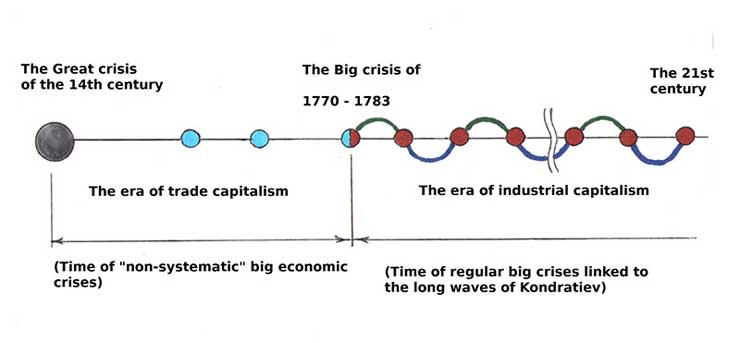
existed before. Their full range is: 1770-1783, 1810-1820, 1847-1850,
1873-1879, 1899-1904, 1929-1933, 1948-1949, 1973-1982 and 2008-2020. In
Figure 1. their place in the development process can be seen.
Figure. 1 Large economic crises before and after the industrial turn of 1770-1783.
Rallies, demonstrations, strikes, occupation of campuses and slogans
at lectures in the name of democracy everywhere and always all this
remained in the past by the end of the crisis-era of the 1970s. The turn
was painful, difficult and most importantly (it always happens) there
have been such shifts in the global economy, and then in technology that
weakened the old industrial regions of the West. The removal of
industry to peripheral countries, the growth of office facilities in the
old centres of capitalism meant a change in the sphere of social
relations and ideas.
Neoliberal withering of democracy
Immanuel Wallerstein could write volumes about the “1968 revolution,”
but big business was the real winner. But its victory was dictated not
so much by a clash with the “lower strata” as by failures during the
years of the crisis of 1973-1982, which showed the need for fundamental
changes in economic policy. Keynesianism has used up its historical
resource.
With changes and for the sake of change neoliberal forces came to
power, demanding the market to be unchained to complete freedom and the
role of the state in regulation to be reduced. The main idea was simple:
let the central banks rule with the help of monetary instruments. From
the point of view of democracy, this means abandoning an extremely
important sphere out of public control. Later, the United States will
impose on countries the independence of central banks from the
authorities, and Naomi Klein in the book “The Doctrine of Shock” will
devote many pages to uncovering the negative consequences of such
changes[6].
If central banks are independent or almost independent of the
government, they are very little dependent on society. But did this mean
that Western democracy shrank like the shagreen skin from Honore de
Balzac’s work only due to this? In the 1980-1990s the importance of
trade unions declined and the importance of left-wing parties simply
collapsed. Being very serious during the crisis of the 1970s, with the
collapse of the USSR they turn into parties on the political sidelines
or adopt neoliberal programmes. From that moment on, all influential
forces can be divided into open liberals and those masquerading as
socialists, social democrats and even communists. The Green are a
special type of disguise, a very effective one. The masses lose
confidence in parties and the parties often lose their mass origins.
They do not lose touch with their clientele, they even develop it, but
they cease to be agents of the “lower strata” in the political system.
The party nomenclature is adjusted to the time politically and the
“lower strata” economically.
All this undermines the foundation of the very bourgeois democracy in
which the propertied classes were forced to take into account the
demands of the masses, since these masses had strong agents. The masses
themselves were their strength. With the decline in the industrial
organisation of the “lower strata,” their role in public life also
deminishes. Now they are required to vote in the elections, the
procedural instance of procedural liberal democracy, having even lost
the indirect and largely formal power of the “demos”. But this “demos”
seems to betray its former self. It follows neoliberal ideas and forces,
turning away from radical left or national-conservative preachers.
When procedures prevail
Without taking into account the fact that the majority of citizens of
industrialised countries followed neoliberals, such as Margaret
Thatcher in the UK and Ronald Reagan in the USA, it is impossible to
understand the causes of the crisis of Western democracy and its basic
structures. Of course, one can believe the version that the “lower
strata” were insidiously deceived, blindly followed the masters of
hypnotic phrases and therefore lost faith in their own strength, the
strength of their structures and in the chance of democracy. However,
the truth seems different: the working class abandoned democracy and the
basic working structures following the temptation to leave its class.
In those days, it was about turning people into owners of state and
municipal housing (privatisation), creating small business, corporate
careers, or just working in an office, which was very different from
working in a factory. The temptation included the ability to dress in
business style, dine in cafes and restaurants, and generally increase
consumption. Many were not concerned about democracy. They did not turn
against it, but its transformation into procedural democracy was not
stopped.
It is amusing, but the Western working class surrendered its
democratic and highly conditional dictatorship to bourgeois political
management almost as quickly as the working class in Soviet Russia in
1918-1919 in a deal with party nomenclature exchanged its democratic
dictatorship for new opportunities. They also included vertical mobility
for some: opportunities to go up the social ladder. As a result, in the
West the model of liberal democracy was established, a procedural
democracy and much more formal than the form that preceded it. And if
the electorate could choose parties or candidates at will, they would
still get the same result, since ideologically the elections had almost
no alternative. And the liberal spirit of this “democracy” was most
expressed in this.
[3] Report of the Department of Political Economy and the History of
Economic Science of the Plekhanov Russian University of Economics
“Donald Trump i ekonomisteskaya situatsiya: strategiya kandidatov v
presidenty i Vroraya volna krizisa v SSHA” // Institute for
globalisation and social movements. – URL: http://igso.ru/trump_situation/ (publication date: 28.10.2016; reference date: 27.08.2018).
[4] Braudel F. Materialnaya tsivilizatsiya, ekonomica i kapitalizm
XV-XVIII . Vol. III. Vremya mira — М.: «Progress», 1992. — p. 76-77.
[5] Report of the Institute for globalisation and social movements.
(IGSO) «Krizis globalnoy economiki i Rossiya» // Institute for
globalisation and social movements.. – URL: http://igso.ru/world_crisis_and_russia/ (publication date: 09.06.2008; reference date: 28.01.2020).
[6] Klein Naomi. Shock Doctrine: The Rise of Disaster Capitalism – M.: «Dobraya kniga», 2009, p. 890.


 Ο σερβοαμερικανός οικονομολόγος Μπράνκο Μιλάνοβιτς
 Ο
Μιλάνοβιτς διακρίνει ήδη πρώτες εκφάνσεις «πλουτοκρατίας» η οποία θα
μπορούσε να εξαλείψει τον φιλελεύθερο καπιταλισμό και τη δημοκρατία
Ο
Μιλάνοβιτς διακρίνει ήδη πρώτες εκφάνσεις «πλουτοκρατίας» η οποία θα
μπορούσε να εξαλείψει τον φιλελεύθερο καπιταλισμό και τη δημοκρατία



Δεν υπάρχουν σχόλια:
Δημοσίευση σχολίου