Ετικέτες

Εμφάνιση αναρτήσεων με ετικέτα Ζωικό Βασίλειο. Εμφάνιση όλων των αναρτήσεων

Κυριακή 18 Οκτωβρίου 2020

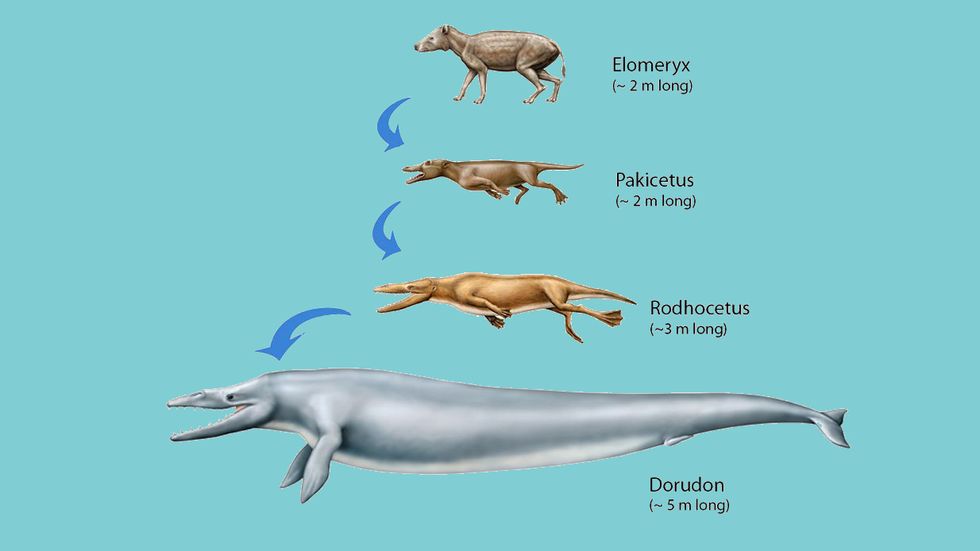
Ancient deer-like creatures returned to the ocean to become whales. But why?


 Whale evolution. Image: John Klausmeyer/University of Michigan Museum of Natural History

Researchers are starting to get a handle on why ancient creatures returned to the ocean after their ancient ancestors climbed out of it. Philip Perry 22 March, 2018 Whale evolution. Image: John Klausmeyer/University of Michigan Museum of Natural History The evolution of whales. Image: John Klausmeyer/University of Michigan Museum of Natural History The ocean may be the origin of all life on Earth, but that isn’t to say that all the animals who evolved on land left the water behind forever. In fact, we’re starting to get a pretty good picture of why certain species that returned back to the water decided to do so and how they developed into the marine animals we know today. Paleontologists say creatures began exploring the land during the Silurian period (440-410 million years ago). No one is sure why this occurred. Some scientists say it may have been tight competition for resources in marine environments that pushed species to look for food elsewhere. The first land explorers were arthropods, who started spending just a little bit of time on the surface and then began doing so more and more.

Σάββατο 17 Οκτωβρίου 2020

Fossil Site Reveals How Mammals Thrived After the Death of the Dinosaurs

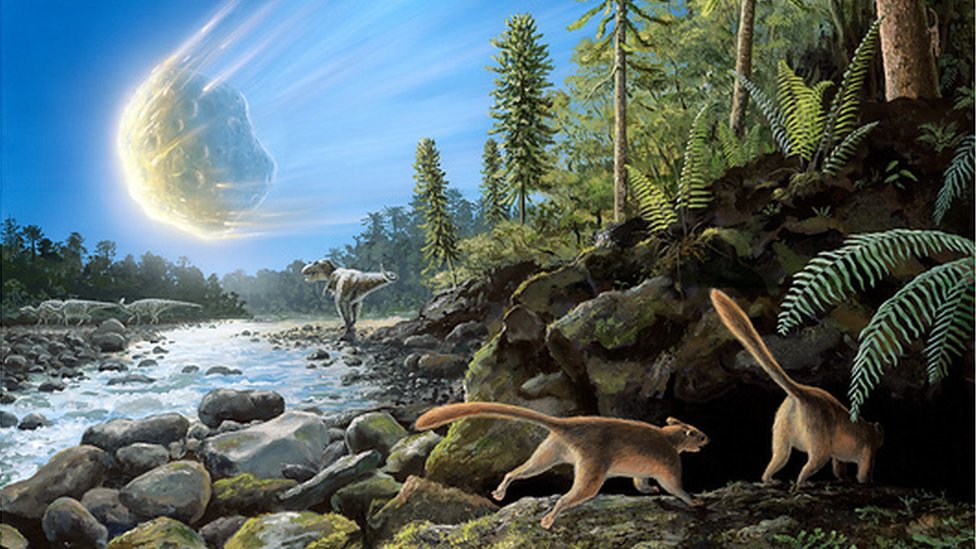
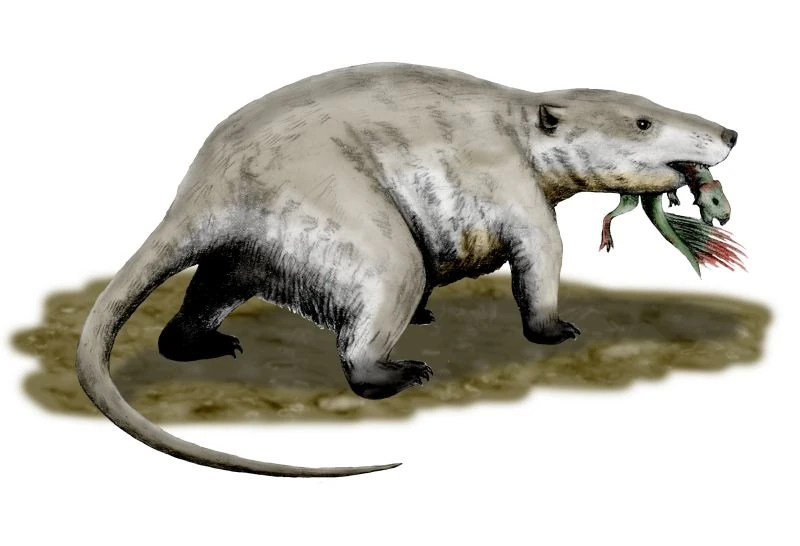
Recent discoveries highlight how mammals lived before and after the asteroid impact that triggered the world’s fifth mass extinction Loxolophus CGI rendering of ancient Loxolophus mammal taken from the PBS NOVA special, Rise of the Mammals. In this recreation, Loxolophus scavenges for food in the palm dominated forests found within the first 300,000 years after the dinosaur extinction. (HHMI Tangled Bank Studios) By Riley Black smithsonianmag.com October 24, 2019
In central Colorado, at a place called Corral Bluffs, there lies an unusual graveyard. The ranks of the dead aren’t filled with people, but animals that lived 66 million years ago. Preserved in hardened concretions of stone lie the remains of turtles, crocodiles, and most of all, mammals that lived in this place during the first million years after the terrible impact that triggered the extinction of the dinosaurs. These animals form a part of our own evolutionary narrative—the story of how mammals went from scurrying around the feet of larger creatures to dominating the continents of the world, evolving into a variety of unique beings, including ourselves. Mammals are not recent additions to the world that came after the time of the dinosaurs. The oldest mammals go back much further in time, and contrary to the standard story of shrew-like critters kept in check by monstrous reptiles, mammals thrived during Mesozoic era. The asteroid impact that felled the “terrible lizards” was also a portentous event for the mammals that had already been plying their own success for tens of millions of years.
The mammalian story is a complicated one. Paleontologists still don’t entirely agree about the identity of the very first mammals. Modern mammals are easy to spot—they have mammary glands and produce milk, among other traits like delicate inner ear bones and fur. These characteristics are what gives our family the name “mammal.” But further back into the fossil record, the only way to identify a mammal is from bones, teeth and shared anatomical features. Mammal Skulls A collection of four mammal skulls collected from Corral Bluffs (Left to right: Loxolophus, Carsioptychus, Taeniolabis, Eoconodon.) (HHMI Tangled Bank Studios) Depending on who you ask, mammals can be regarded as a broad group called mammaliformes that appeared by the Late Triassic—when dinosaurs were just beginning to diversify themselves—around 220 million years ago. But mammaliaformes is a broad group that includes lineages that are totally extinct today. The last common ancestor of all modern mammals lived sometime during the Jurassic, over 160 million years ago. Regardless of what was the earliest mammalian beast, though, animals very closely related to mammals have been around for nearly as long as the dinosaurs, and they underwent an evolutionary explosion during the Mesozoic. “Often people are surprised to hear that mammals were around at all in the Mesozoic,” a time usually associated with dinosaurs and other reptiles, says University of Oxford paleontologist Gemma Louise Benevento. And even when mammals are included in studies of the Mesozoic, they are often characterized as small, shrew-like insectivores like the 205 million-year-old Morganucodon from Wales and China. This picture, Benevento says, primarily comes from 100-year-old research carried out on North American fossil mammals, where the record of tiny teeth and bones ostensibly shows mammals scurrying in the shadows of caves until after the extinction event at the end of the Cretaceous period. But recent discoveries around the world have changed the story, revealing that mammals were thriving alongside the dinosaurs. Mesozoic beasts came in many forms. Castorocauda was the Jurassic equivalent of a beaver, complete with a scaly, flattened tail. Volaticotherium, from about the same time, resembled a flying squirrel. Fruitafossor, by contrast, was like a Jurassic aardvark, with powerful limbs that appear well-suited to tearing open termite nests. And the badger-sized Repenomamus was an omnivore that, thanks to fossil stomach contents, we know ate baby dinosaurs. Every year a few more mammal ancestors are added to the list. Then, one day 66 million years ago, a catastrophic asteroid impact triggered a devastating mass extinction that killed off nearly all dinosaurs—leaving only birds—and reshuffled the evolutionary deck for mammals. The event is often interpreted as a stroke of cosmic luck that allowed mammals to step out of the shadow of the reptiles and expand in size, shape, behavior and habitat. But as paleontologists continue to dig into the critical time after the impact, the story is becoming more complex. The rise of the mammals was not necessarily assured, and recovery from the disaster took far longer than expected. Corral Bluffs A scenic vista of Corral Bluffs, outside of Colorado Springs, Colorado. Corral Bluffs represents about 300 vertical feet of rock and preserves the extinction of the dinosaurs through the first million years of the Age of the Mammals. (HHMI Tangled Bank Studios) The fossils of Corral Bluffs are part of that story. Described by Denver Museum of Nature and Science paleontologist Tyler Lyson and colleagues, the stacks of fossils and rock in this pocket of Colorado document approximately the first million years of the Paleocene, the time period directly following the Cretaceous after the mass extinction. Correlating the mammal fossils to others from the site and a carefully calibrated timescale, the research team was able to come up with a rough timeline of how mammalian beasts transformed in a world where the likes of Tyrannosaurus no longer roamed. Mammals did not emerge from the extinction event unscathed. Before the asteroid strike, Lyson says, the largest mammals were about the size of a raccoon. Immediately after, the biggest mammals were about rat-sized. But in a world without towering dinosaurs, new opportunities opened for mammals. “Within 100,000 years after the extinction, we have a different type of raccoon-size mammals,” Lyson says, with additional fossils from Corral Bluffs revealing an increase size over time. By the 300,000-year mark, the biggest mammals were about the size of large beavers, and those that lived 700,000 years after the impact could weigh over a hundred pounds, such as Ectoconus ditrigonus, a herbivore unlike any mammal alive today. “This is a hundred-fold increase in body size compared to the mammals that survived the extinction,” Lyson says. Mammals wouldn’t go through this sort of rapid growth again for another 30 million years. Skulls and Jaws An overhead shot of the prepared mammal skull fossils and lower jaw retrieved from Corral Bluffs. (HHMI Tangled Bank Studios) The question facing paleontologists is what spurred this rapid growth. A combination of factors were likely at play. Not only did the dinosaurs that munched mammals disappear, but a warming global climate changed the makeup of forests and allowed for the evolution of new plants. Legumes—energy-rich plants and the ancestors of bean—evolved for the first time. The botanical changes may have helped provide the fuel for mammalian growth, Lyson says, with climate, plants and mammals all tied together in a story of recovery from one of the world’s most devastating mass extinctions. “For the first time, we are able to link changes in plants and animals together, and more importantly, we are able to place all of these changes in a high-resolution temporal framework,” Lyson says. Despite the relief of living in a world without rapacious dinosaurs, mammals took time to expand into the wildly varied family of beasts that diversified throughout the Cenozoic, from herbivorous “thunder beasts” to saber-toothed cats to walking whales. Earlier this year, Benevento and colleagues published a study looking at mammal jaws from the Mesozoic and into the following Cenozoic era. The researchers were interested in the different shapes that mammal jaws took as related to diet. What they found was that mammal jaw disparity—and therefore the variety of herbivores, carnivores, omnivores and insectivores—rose sharply during the Mesozoic, before the impact. Carsioptychus Rendering CGI rendering of ancient Carsioptychus mammal taken from the PBS NOVA special, Rise of the Mammals. In this recreation, Carsioptychus coarctatus eats plants in a newly diversified forest, ~300,000 years after the mass extinction that wiped out the dinosaurs. (HHMI Tangled Bank Studios) But the extinction changed mammalian luck. Even though the variety of jaw shapes stayed the same through the extinction event, Benevento says, different mammals rose while the old varieties died off. The extinction was terrible for the more archaic mammals but a boon to our distant relatives and ancestors, allowing more modern mammals to take up the ecological roles previously filled by other species. “Between the Cretaceous and Paleocene, we have an extinction and turnover of mammals with one group decreasing and the other increasing,” Benevento says. The rise of mammals took time. It wasn’t until the Eocene, more than 10 million years after the impact, that mammals became truly large and evolved into an array of beasts to rival the dinosaurs. “There are no known mammals filling the large grazer niche in the Mesozoic,” Benevento says, and it took about 10 million years for herbivorous mammals to grow big enough resemble today’s bison and antelope. It’s easy to take the evolutionary success of mammals as a foregone conclusion, especially given that we’re a part of the family, but new fossils are only just now revealing the deep and tangled roots of our own evolutionary tree.

Παρασκευή 16 Οκτωβρίου 2020

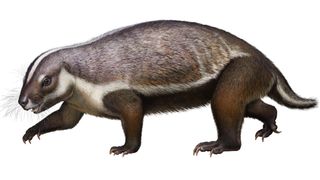
Ancient 'crazy beast' from Madagascar had mismatched body and teeth from 'outer space'


This life-like reconstruction of Adalatherium hui from the late Cretaceous of Madagascar shows off the creature’s weird-looking body and plentiful whiskers.
(Image: © Denver Museum of Nature & Science/Andrey Atuchin)

The oldest complete mammal fossil from the Southern Hemisphere is puzzling scientists with its mismatched body, strange skull holes and teeth that look like they're "from outer space."

Πέμπτη 15 Οκτωβρίου 2020

Rise of mammals 'began well before dinosaur extinction'


Published

Dinosaur extinctionimage copyrightRICHARD BIZLEY/SCIENCE PHOTO LIBRARY
image captionAn asteroid impact is thought to have wiped out most dinosaurs around 66 million years ago

Mammals began to flourish well before the end of the dinosaur age, a new study has found.

The study saw hundreds of mammal fossil teeth analysed by the Universities of Southampton and Chicago.

The findings showed those with varied diets began to adapt 10 to 20 million years before the dinosaurs died out.

Τετάρτη 14 Οκτωβρίου 2020

The Evolutionary History of Ichthyosaurs


By
inPaleobiology |
Score: 2.00 / 213

Imagine a world without dinosaurs, but where a diverse bunch of marine alternatives had their celebrity status instead. This is a world that did exist over 175 years ago. The word dinosaur and the scientific concept of dinosaurs as a group of extinct animals was not invented until 1842. Before then, the discovery of many remarkable marine reptile fossils, especially ichthyosaurs, captivated the public imagination in the way that dinosaurs do today (Figure 1).

Τρίτη 13 Οκτωβρίου 2020

Mammals in the Age of Dinosaurs


By
inPaleobiology |
Score: 3.87 / 422

Introduction

Sixty-six million years ago a worldwide cataclysmic event marked the end of the Mesozoic Era and changed the whole course of life on earth (Fig. 1). This was the end-Cretaceous mass extinction, and whether it was caused by a bolide strike or triggered by huge volcanic eruptions remains hotly debated. There is geological evidence for both at the time. The outcome, however, is indisputable. The dinosaurs that had dominated the land vertebrate fauna for the previous 125 million years completely and abruptly disappeared, along with the related flying pterosaurs, and the great marine reptiles, the ichthyosaurs, plesiosaurs and others. The vertebrate survivors included birds (which are technically miniature, feathered, flying dinosaurs) and the crocodiles, lizards, snakes and turtles. All of these groups soon proceeded to diversify, although none of them underwent any great evolutionary transformations in body form. A small number of the pre-existing mammals also survived the extinction, but their story was very different. Over the course of the following 66 million year Cenozoic Era, an astonishing array of entirely new kinds of mammals soon evolved. Small, nocturnal ancestors gave rise to numerous large bodied herbivores such as antelopes, camels, hippos, horses, rhinoceroses, kangaroos, and elephants, along with the carnivorous cats, wolves, bears, and hyaenas that preyed upon them. Completely novel forms such as anteaters with long sticky tongues and powerful digging claws, and monkeys, apes and sloths adapted for life in the trees evolved, and within just 25 million years the most specialised mammal groups of all appear in the fossil record: the bats are as accomplished fliers as birds, and the whales and dugongs are superbly adapted physiologically and anatomically for a permanent life in the sea.

Δευτέρα 12 Οκτωβρίου 2020

Mammals and their relatives thrived, diversified during so-called 'Age of Dinosaurs'


Mammals and their relatives thrived, diversified during so-called ‘Age of dinosaurs,’ researchers show

Illustration of Didelphodon, a marsupial relative from the Late Cretaceous with the strongest pound-for-pound bite force of any known mammal. Credit: Misaki Ouchida

Paleontologists are trying to dispel a myth about what life was like when dinosaurs roamed the Earth. The false narrative has wormed its way into books, lectures and even scientific papers about this long-ago era.

The myth's focus isn't on dinosaurs. Its main characters are ancient mammals and their relatives, which together are known as mammaliaforms. According to the myth, a world crowded with dinosaurs left little room for mammaliaforms. As a result, mammals and their kin remained tiny, mouse-like and primitive. The myth posits that mammals didn't evolve diverse shapes, diets, behaviors and ecological roles until the K-Pg mass extinction event 66 million years ago killed off the dinosaurs and "freed up" space for mammals.

Κυριακή 11 Οκτωβρίου 2020

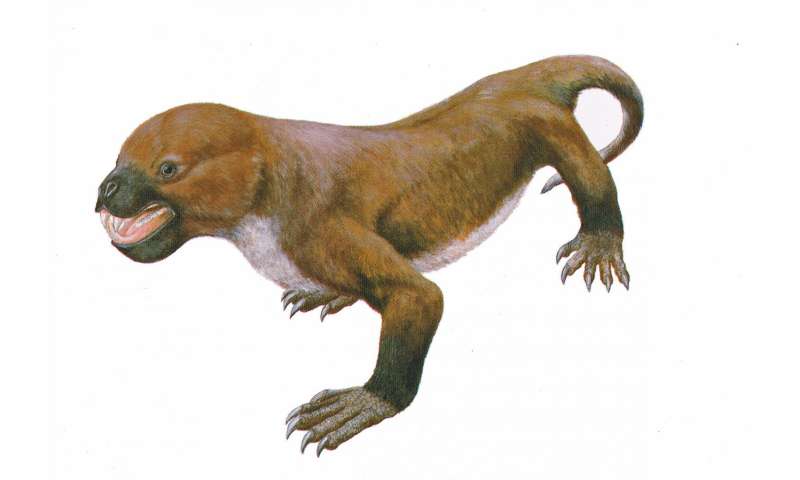
Mammal-like reptile survived much longer than thought


Mammal-like reptile survived much longer than thought

Tritylodontids are the last known family of near-mammalian reptiles, before mammals with features such as advanced hearing evolved. Researchers have uncovered dozens of fossilized teeth in Kuwajima, Japan and identified this as a new species of tritylodontid. This suggests that tritylodontids co-existed with some of the earliest mammal species for millions of years. Credit: Seishi Yamamoto/Hiroshige Matsuoka

Σάββατο 10 Οκτωβρίου 2020

Mammals from Early Cretaceous Epoch


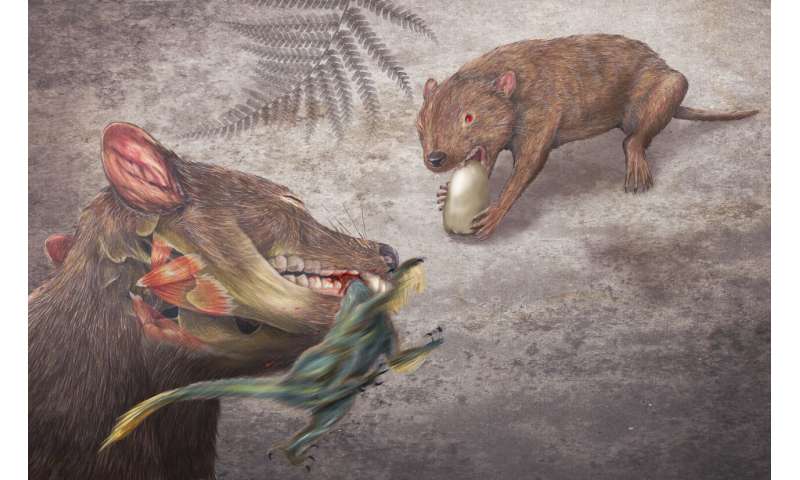
A group of paleontologists from the University of Portsmouth has discovered two new species of mammals that lived 145 million years ago in what is now Dorset county, southern England.

Artist’s impression of a lagoon at dusk with Durlstodon ensomi (left foreground), Durlstotherium newmani (right and center foreground) and the theropod Nuthetes holding a captured Durlstotherium newmani (center middle distance). Image credit: Mark Witton.Artist’s impression of a lagoon at dusk with Durlstodon ensomi (left foreground), Durlstotherium newmani (right and center foreground) and the theropod Nuthetes holding a captured Durlstotherium newmani (center middle distance). Image credit: Mark Witton

Παρασκευή 9 Οκτωβρίου 2020

Mammal evolution: ancient mammals that lived in the age of dinosaurs


Our mammalian ancestors were eking out an existence even before T. rex came stomping along. We can reveal their story by studying beautiful, new fossils from China.

Πέμπτη 8 Οκτωβρίου 2020

Mammal evolution: How ancient fossils are revealing the secrets of our earliest ancestors


A few years ago, I visited Liaoning Province in China, to study the region’s famous feather-covered dinosaur fossils. One day, after many hours of measuring bones and photographing feathers in a museum, I needed a break.

My Chinese colleagues exchanged a few hushed words of Mandarin and motioned for me to follow. “We have something secret to show you,” one of them said. “And it’s not a dinosaur.”

We left the museum, hopped into a car, and snaked through the narrow streets of Beipiao city, clogged with bicycles and noodle vendors. We pulled into an alleyway that opened into a small courtyard. Into a dark apartment we ventured, sidestepping a clutter of boxes and wooden crates.

One of my colleagues ducked into a side room and came out holding two rock slabs that fitted together like a jigsaw puzzle. On the surface was a brown smear, about the size of an apple

Mamals in the Era of Dinosaurs (Pictures)


Repenomamus mammals hunting for prey during the Mid-Jurassic Period of Europe. - Image ID: E1JM5E


Repenomamus BW

Repenomamus

Repenomamus was the largest mammal of the Age of Dinosaurs. It was the first evidence of a Mesozoic mammal that was bigger than a mouse. In fact, Repenomamus was 3 feet long and weighed 26 to 31 pounds. This made it bigger than most of the dinosaurs of Liaoning, where it lived. In fact, there is even evidence that some dinos should have hidden from Repenomamus. In the stomach of Repenomamus were the bones of a baby Psittacosaurus. This is evidence that mammals were starting to get their revenge on dinsaurs by eating them. This would make Repenomamus the T-rex of Mesozoic mammals.

Δευτέρα 17 Οκτωβρίου 2016

New pterosaur species discovered in the Patagonia region of Argentina


new-pterosaur-species-patagonia-argentina_1Reconstruction of a ptesosaur. Credit: Gabriel Lío
Researchers announced the discovery of a new (extinct) species of pterosaur from the Patagonia region of South America. The discovery was made from the cranial remains of a specimen that were found to be a pretty well preserved condition, probably dated from the Early Jurassic period (around 200 – 175 million years ago). Interestingly enough, the new species was named as the Allkauren koi, from the native Tehuelche language – with ‘all’ roughly translating to ‘brain’ and ‘kauren’ meaning ‘ancient’.

The very name ‘Pterosaur’ comes from the Greek for ‘winged lizards’. These astounding flying reptiles ruled the skies between the late Triassic to the end of the Cretaceous Period; and quite unsurprisingly, one of the largest known flying animals of all time – Quetzalcoatlus, comes from this extinct clade. In terms of size, the larger variant of Quetzalcoatlus’ is estimated to have had an incredible wingspan of over 36 ft. But interestingly this was just one end of the size spectrum, with some Pterosaur specimens also showcasing the diminutive dimensions of small sparrows.

Τετάρτη 7 Σεπτεμβρίου 2016

Δεν θα το ΠΙΣΤΕΥΕΤΕ! ΔΙΑΣΤΑΥΡΩΝΟΥΝ ανθρώπους με ζώα στη Βρετανία...


Σε τρία εργαστήρια στην Βρετανία, των πανεπιστημίων King College, Newcastle και Warwick, έχουν χορηγηθεί άδειες για να διεξάγουν πειράματα δημιουργίας υβριδίων ανθρώπου με ζώα, μετά την εφαρμογή  σχετικού ψηφίσματος.

Τετάρτη 3 Αυγούστου 2016

Τι έγινε πριν 66 εκ. χρόνια, την ημέρα που εξαφανίσθηκαν οι δεινόσαυροι- Οι έρευνες και η σχέση τους με το σήμερα

Εξήντα έξι εκατ. χρόνια πριν, ένας αστεροειδής προσέκρουσε  στο ανατολικό Μεξικό και εξαφάνισε τους δεινόσαυρους. Τώρα οι επιστήμονες, χάρις στη νέα τεχνολογία, έχουν πολύ καλύτερη εικόνα του τι συνέβη εκείνη την πολύ-πολύ μακρινή ημέρα.

Κυριακή 26 Ιουνίου 2016

After the Battle of Shiloh Some Civil War Soldiers Actually Glowed in the Dark!


There are many remarkable stories of the American Civil War. One of the most striking, however, is the story of the soldiers who glowed in the dark. By the spring of 1862, it was clear that the Civil War was going to be bloody and long . Major General Ulysses S. Grant had pushed deep into the Confederate-led South along the Tennessee River. That April, he camped at Pittsburgh Landing near Shiloh, Tennessee, waiting for the arrival of Major General Don Carlos Buell and his army.

Τετάρτη 20 Απριλίου 2016

Κάρολος Δαρβίνος 1809 – 1882


Κάρολος Δαρβίνος

Άγγλος φυσιοδίφης, που επέφερε επαναστατικές αλλαγές στην ανθρώπινη γνώση με τη θεωρία του για τη βιολογική εξέλιξη μέσω της φυσικής επιλογής.
Ο Κάρολος Δαρβίνος, όπως είναι γνωστός στην Ελλάδα ο Τσαρλς Ρόμπερτ Ντάργουιν (Charles Robert Darwin), γεννήθηκε στις 12 Φεβρουαρίου 1809 στο Σρούσμπερι της Δυτικής Αγγλίας. Ήταν γιος του γιατρού Ρόμπερτ Ντάργουιν και της Σουζάνας Γουέτζγουντ, κόρης του περίφημου αγγειοπλάστη Τζοσάια Γουέτζγουντ.

Benjamin was the last Tasmanian tiger and it was left out in the cold to die in 1936


qazerwx
Thylacine,  commonly known, as the Tasmanian tiger (because of its striped lower back), once native to continental Australia, Tasmania, and New Guinea, it is believed to have become extinct in the 20th century.
Surviving evidence suggests that it was a relatively shy, nocturnal creature with the general appearance of a medium-to-large-size dog, except for its stiff tail and abdominal pouch (which was reminiscent of a kangaroo) and a series of dark transverse stripes that radiated from the top of its back (making it look a bit like a tiger). Like the tigers and wolves of the Northern Hemisphere, from which it obtained two of its common names, the thylacine was an apex predator.

Πέμπτη 14 Απριλίου 2016

Meet Wojtek – A soldier bear, a weapons carrier for the Polish Аrmy during WWII


Wojtek (1942–1963) usually spelled Voytek in English, was a Syrian brown bear found in Iran and adopted by soldiers of the 22nd Artillery Supply Company of the Polish II Corps. He was later officially enlisted as a soldier of the company with the rank of Private and subsequently became a Corporal. During the Battle of Monte Cassino, Wojtek helped move crates of ammunition. The name “Wojtek” is a diminutive (Hypocorism) form of “Wojciech”, an old Slavic name that is still common in Poland today and means “he who enjoys war” or “joyful warrior”.


He was the largest and undoubtedly most intimidating fighting force of the Polish Army. source
In the spring of 1942, the newly formed Anders Army left the Soviet Union for Iran, accompanied by thousands of Polish civilians who had been deported to the gulags following the Soviet invasion of Poland in 1939. During a rest stop near the town of Hamadan while en route to Tehran on 8 April 1942, a group of Polish soldiers encountered a young Iranian boy who had found a bear cub after its mother had been shot by hunters. One of the civilian refugees in their midst, eighteen-year-old Irena Bokiewicz, was very taken with the cub, which prompted lieutenant Anatol Tarnowiecki to purchase the young bear, who spent the next three months in the Polish refugee camp that was established near Tehran, principally under the care of Irena. In August the bear was donated to the 2nd Transport Company, which later became the 22nd Artillery Supply Company, and he was given the name Wojtek by the soldiers.