Ο
Σίσι το είπε και το έκανε και έφερε τον αιγυπτιακό στόλο στην Μαύρη
Θάλασσα. Έτσι η χώρα της Βορ.Αφρικής βρίσκεται πλέον στις βόρειες ακτές
της Τουρκίας για ασκήσεις με το ρωσικό ναυτικό. Για πρώτη φορά
αιγυπτιακά πολεμικά πλοία πέρασαν τα Δαρδανέλλια, όπως σημειώνουν τούρκικα μέσα με έκδηλη ανησυχία.
Read this fascinating tale of state power over
commonsense military design. Stalin wanted a land battleship, and he was
going to get one no matter how
impractical it was.
Since the collapse of the Soviet Union, new facts have surfaced about the secret weapons developed by the Red Army during WWII.
Underwater photos by Tomasz “Tomek” Stachura
Graf
Zeppelin (Flugzeugträger A, Aircraft Carrier A) was the only aircraft
carrier launched by Germany during World War II. It represented part of
the Kriegsmarine’s attempt to create a well-balanced oceangoing fleet,
capable of projecting German naval power far beyond the narrow confines
of the Baltic and North Seas.
A diving team from Poland, including
experienced scuba divers Dimitris “Dima” Stavrakakis and acclaimed
underwater photographer Tomasz “Tomek” Stachura share with
pierrekosmidis.blogspot.com their experience and stunning underwater
photos of a unique WW2 Wreck, the only German aircraft carrier that was
never meant to see active duty.
Stavrakakis says:
“The
diving expedition was well prepared and planned, since we were the
first scuba divers to visit the shipwreck, with special permission from
the authorities.
“We had two doctors and a hyberbaric chamber on
board, because of the demanding nature of those dives at depths ranging
from 75 to 95 metres.
By Pierre Kosmidis / pierrekosmidis.blogspot.gr
A
Second World War mega-submarine of Imperial Japanese Army had been
successfully mapped and filmed, a year and half after it was first
discovered off the coast of Hawaii.
Decades
ahead of its time, the I-400 submarine was among the largest and
technologically most advanced submarines of its era. The aircraft hangar
of the submarine was large enough to facilitate the launch of at least
three float-plane bombers.
Here
she is in all her glory. Type XII introduced streamlining in U-Boat
design, resulting in a quantum leap in underwater performance. All
submarines before this one were basically designed to submerge and stay
under the surface in one place (sans minor pedestrian manoeuvres using
electric power). Type XXI could easily steam in circles around any
Allied convoy – all under water. sourceU-2540
was an advanced submarine which entered service on 24th February 1945.
Less than 3 months later, on 4th May, she was scuttled by her own crew.
In
1957, she was raised and returned to service on 1st September 1960 as
the research submarine Wilhelm Bauer. She served in a civilian role
under various research projects before decommissioning on 15th March
1982. On 24th April 1984, she was transferred to the Deutsches
Schiffahrtsmuseum (German Maritime Museum) as the Technikmuseum Wilhelm
Bauer.
The
entrance to the museum is adorned by two propellers, one of which is
shown here. I’m quite certain that these are the original propellers of
this U-boat. sourceIn
the spring of 1943, Germany was clearly losing the battle of the
Atlantic. Improvements in Allied escort material and tactics, combined
with cracking the German military code dramatically increased the
U-Boats´ losses, rendering them near useless. The German high command
saw its best reaction in the speedy development of improved submarines.
Autro-Hungarian armored train, 1915. Wikipedia, Public Domain,
Armored
trains are a relic of the past by today’s standards but in the late
19th and early 20th century, these big steel-plated locomotives besieged
cities, pierced frontlines and supported infantry attacks all over the
world.
The beasts of the railroads began their epic service in the
American Civil War when a single car was built to defend the
Philadelphia, Wilmington and Baltimore Railroad. Then war trains saw
action in the Franco-Prussian War of 1870, and the First and the Second
Boer Wars which led the machines into the 20th century.
An 1861″Railroad
battery” used to protect workers during the American Civil War. By
Sketch by William C. Russell, engraver unknown, for Frank Leslie’s
Illustrated Newspaper – Frank Leslie’s Illustrated Newspaper. Page 9,
May 18, 1861, No. 287–Vol. XII. From digital scan at
http://archive.org/details/franklesliesilluv1112lesl, Public Domain,
https://commons.wikimedia.org/w/index.php?curid=20572199In
1905, these trains were used in the Far East as part of the
Russo-Japanese War, where the advantage of a large armored vehicle on
rails during harsh winters proved to be irreplaceable. Russia later saw
the even more extensive use of armored trains during the First World War
and the Civil War which commenced immediately after the October
Revolution.
Trains
were seen as transport mainly at the time, as they were capable of
carrying a large number of people and equipment in a short period of
time. Its transport use revolutionized the way battlefield logistics
were executed at the time. The fact that the machine was tied to the
tracks didn’t represent such a disadvantage, for this was the only dawn
of the automobile age and the four-wheelers were still lagging behind
the locomotive.
Needless to say, tanks were only in development
during the First World War, so flawed designs often lost sympathy in the
military, and trains proved to be more reliable. Mounted with cannons
and encased with thick armor, the trains were fearsome fighting
machines.
A typical Polish artillery car from 1939. Public Domain, https://commons.wikimedia.org/w/index.php?curid=89125But
trains are perceived as transport mainly today, so this appendix of
history takes place in a time before the rapid development of armored
vehicles in the interwar period. During the Mexican Revolution
(1910–1920), the Spanish Civil War (1936-1939) and the Second World War
armored trains were actively used by all parties included in the
conflicts.
In Poland, trains were active in the defense effort of
the September campaign against the invading Germans. The Germans, on the
other hand, developed super cannons on a train chassis, most famous
being the Schwerer Gustav, which saw limited service, but had a
devastating effect during the siege of Sevastopol.
Apart from
official military use, trains often served as support for partisan
groups which staged massive offensives during the last years of the
Second World War. Such was the case in Slovakia, where three armored
trains ― The Hurban, Štefánik, and Masaryk ― delivered a decisive blow
to the weakened German units in September of 1944.
A Russian WW II-era armored
train with antiaircraft gunners. By Unknown –
http://mechcorps.rkka.ru/files/bepo/media/bepo_094.jpg, Public Domain,
https://commons.wikimedia.org/w/index.php?curid=5150971The
reason for its abandonment was clearly the change within the methods of
warfare, as tanks and motorized infantry dictated military doctrines
that slowly pushed out the armored train. Since trains were limited to
railroads, they were more vulnerable to bombers and artillery.
In
addition to that, the railways were more and more subjected to acts of
sabotage by commando or partisan units, which slowed the advance of the
trains significantly. The mere fact that it relied on the use of tracks
turned these war machines into vulnerable giants.
Nevertheless, trains continued to serve in battle even after WWII (but far less actively), most notably in Indochina.
But
in the countries of the Eastern Bloc, the use of trains as means of
battle was nurtured as a tradition. Even though it was old-fashioned in a
way, it was still suitable for serving as a mobile intercontinental ballistic missile (ICBM)
launching ramp. In the late stages of the Cold War, the RT-23 Molodets,
an intercontinental ballistic missile, entered service in the Soviet
Union during the Cold War.
Rt
23 complex “Molodets” as a cargo train with a sensor for orientation on
the lighting mast. By Vitold Muratov – Own Work, CC BY-SA 3.0,
https://commons.wikimedia.org/w/index.php?curid=27780149It
was capable of carrying a nuclear warhead. One of the options for
transporting and launching the missile was from a specially designed
train across the Trans-Siberian Railway. The strategic importance of
this railway was emphasized during the 1970s after the split between the
Soviet and the Chinese government. According to different accounts,
four or five armored trains were built in order to protect the
southeastern borders of USSR.
Every train included ten main battle
tanks, two light amphibious tanks, several AA guns, as well as several
armored personnel carriers, supply vehicles and equipment for railway
repairs. They were all mounted on open platforms or in special rail
cars. Different parts of the train were protected with 5–20mm-thick
armor.
So it is not surprising that some of the last known uses of
armored trains happened during the conflicts following the collapse of
the Soviet Union 1990s, most notably in the disputed area of
Nagorno-Karabakh, between today’s Armenia and Azerbaijan.
Also,
during the Yugoslav Wars from 1991 to 2001, some improvised armored
trains were used by paramilitaries in the conflict in Croatia and
Bosnia. These were regular passenger trains transformed into terrible
land cruisers, capable of laying siege to towns and villages across the
war-torn Bosnia.
The
most infamous train that was in service during those years was the
Krajina Ekspres, employed by the members of a Serbian paramilitary in
Bosnia. The train took part in a three-year-long siege of the town of
Bihac, which lasted from 1992 to 1995.
Even then the technology
was considered to be obsolete, but in a conflict between various
paramilitary and guerilla groups, such hardware proved to be
intimidating. In late 2015, Pro-Russian militants in the Donbass region
of Ukraine were pictured operating a homemade armored train.
One
armored train that remains in regular use is that of Kim Il-sung and Kim
Jong-il, which the former received as a gift from the Soviet Union and
the latter used heavily for state visits to China and Russia as he had a
fear of flying.
The
Heavy Assault Tank or Assault Gun, Tortoise, was a British tank design
developed in World War II but never put into mass production. It was
developed for the task of clearing heavily fortified areas and as a
result favoured armour protection over mobility.
In the early part
of 1943, the Allied forces anticipated considerable resistance in the
projected future invasion of Europe, with the enemy fighting from
heavily fortified positions such as the Siegfried Line. As a result, a
new class of vehicles emerged, in the shape of Assault tanks, which
placed maximum armour protection at a higher priority than mobility.
Just
one of the amazing pictures uncovered from the mysterious rolls of film
by the Rescued Film Project. (Image captured from the vIdeo below)
The
Second World War is considered to be one of the most filmed and
photographed conflict in recorded history. There were photographers
attached to the armies, recording every battle. They filmed and
photographed destroyed cities, piles of bodies, scared and shaken
citizens and starving Holocaust survivors.
Recent studies show
that there were many individuals filming the conflict, but that most of
those films were either lost during the war or were not developed in the
years following.
Photographer Levi Bettwieser discovered an amazing set of rolls in 2014. He runs the ‘Rescued Film Project’, paying tribute to the unknown photographer who had created the film during the war.
The
Rescued Film Project is a short documentary about the processing of
these mysterious film rolls. The process itself was quite an
exhilarating experience for him, but when he developed and saw the
pictures, he was astonished by his discovery.
U-848
is bracketed by five depth charges dropped by United States Navy PB4Y-1
Privateer "107-B-4" flown by Lieutenant Samuel K. Taylor of Patrol
Bombing Squadron VB-107. Lieutenant Taylor attacked from seventy feet
(21 meters) at 225 knots (415 kilometers per hour). This ninth attack in
one day on U-848 was followed by another run by Lieutenant Taylor, who
destroyed the U-Boat with two depth charges. U-848, a Type IXd2 U-Boat,
was commissioned on February 20, 1943 under the command of
Korvettenkapitan Wilhelm Rollman (August 5, 1907 - November 5, 1943).
Rollman was a U-Boat ace who sank over 100,000 tons while the commander
of U-34.
Panzerkampfwagen
VIII Maus (“Mouse”) was a German World War II super-heavy tank
completed in late 1944. It is the heaviest fully enclosed armored
fighting vehicle ever built. Only two hulls and one turret were
completed before the testing grounds were captured by the advancing
Soviet forces.
These two prototypes – one with, one without turret
– underwent trials in late 1944. The complete vehicle was 33 ft 6
inches long, 12 ft 2 inches wide, and 11.9 ft high. Weighing 188 metric
tons, the Maus’s main armament was the Krupp-designed 128 mm gun. This
128 mm gun was powerful enough to destroy all Allied armored fighting
vehicles then in service, some at ranges exceeding 3,800 yards.
Truly
touching moments of humanity, ethics and morals are rather rare in
warfare. The Christmas Truce of WWI was an excellent example of such
humanity, as were the heroic actions of German Luftwaffe fighter pilot
Franz Stigler on December 20th, 1943. His actions got nine men home for Christmas.
Charlie
Brown of the USAAF was a Lt. flying his first mission as an aircraft
commander flying a B-17, “Ye Olde Pub” on a bombing run over Bremen.
Brown’s bomber occupied the especially dangerous left of the formation,
sometimes called the Purple Heart Corner. Bremen was defended by a large
contingent of fighters and well-manned flak guns. Two B-17s were
quickly struck by heavy flak, and many went down. Brown’s bomber was hit
at least once in the left wing. The crew had to shut down an engine
which took them out of the formation. Soon they were met by about eight
enemy fighters.
The B-17 was sometimes referred to as the flying
porcupine and Ye Olde Pub sure lived up to The name. the gunners took
out at least one of the fighters and as many as three, all on their own.
The remaining fighters were still able to take the fight to the bomber,
however, and bullets tore through Ye Olde Pub.
Great image here for the scale of the ‘flying crane’. sourceOK,
it looked ugly and strange but it worked – kind of. Made from parts
from various WWII warbirds the Hughes XH-17 “Flying Crane” was by far
,the most impressive of all rotor-craft in the early 1950s was a strange
monster designated XH-17. This was planned and taken through the design
process by Kellett, but hardware trials were transferred to Hughes
Aircraft at Culver City. Already the aircraft firm of billionaire Howard
Hughes had a reputation for being quite undeterred by the most
formidable development problems, and certainly the XH-17 made sense on
paper. In any case, it was part-funded by the USAF. It was a flying
crane, the specialized category pioneered by the German Fa 284 and
intended to lift cargo weighing up to 27,000 lb more than ten times as
much as any other rotorcraft of its day. To do so it had a radically new
form of lift power.
Howard
Hughes (second from left) standing under the blade of the XH-17, Flying
Crane with L-R: Rea Hopper, Director of the Aeronautical Division,
Hughes Aircraft Company; Hughes; Clyde Jones, Director of Engineering,
Hughes Tool Company Aeronautical Division; Warren Reed, Assistant;
Colonel Carl E. Jackson, Air Research and Development Headquarters;
Gale. J. Moore, Pilot; Chal Bowen?, Flight Engineer/Co-Pilot;
unidentified pilot. source
Scroll down for video
The
prototype was finished in 1949, ahead of schedule and one of the
reasons being that it was made from parts poached from WWII warbirds.
The XH-17 was a heavy-lift rotorcraft that was designed to lift loads
in excess of 15 metric tons.
To speed construction, parts of the
XH-17 were scavenged from other aircraft. The front wheels came from a
B-25 Mitchell and the rear wheels from a C-54 Skymaster. The fuel tank
was a bomb bay-mounted unit from a B-29 Superfortress. The cockpit was
from a Waco CG-15and the tail rotor from a Sikorsky H-19 was used for
yaw control.
In
the late 1940s, Hughes developed an interest in helicopters. In August
1947, helicopter manufacturer Kellett sold his design for the giant
XH-17 Sky Crane to Hughes, who commissioned the development of the XH-17
Flying Crane research vehicle. In 1948, the XH-17 began to take shape.
The giant helicopter was tested in Culver City, California over a
three-year period beginning in 1952. The XH-17 flew in 1953 at a gross
weight in excess of 50,000 pounds (23,000 kg). It still holds the record
for flying with the world’s largest rotor system. Only one unit was
built, since the aircraft was too cumbersome and inefficient to warrant
further development.
Engines: two GE J35 turbojets Weight fully loaded: 52,000 lb Cruising speed: 60 mph Range: 40 miles Number of seats: 2. sourceThe
propulsion system was unusual. Two General Electric J35 turbojet
engines were used, sending bleed air up through the rotor hub. The
blades were hollow, and the hot compressed air traveled through the
blades to tip jets where fuel was injected. In flight, the rotors spun
at a sedate 88 rpm. Since the rotor was driven at the tips rather than
the hub, little torque compensation was required.
The XH-17 employed an unusual gas-turbine and rotor-tip combustion combination to provide power to spin the gigantic rotors.
Thus, the XH-17 had a very small tail rotor compared to its main
rotor. This drive system was inefficient, limiting the test aircraft to a
range of only 40 miles. Finally, having received the Air Force serial
50-1842, the XH-17 was first flown by Gale Moore at Culver City on 23
October, 1952. That flight, however, had to be cut short after the XH-17
had been airborne for barely a minute as directional control forces
were excessive. While correction of this deficiency could be made
quickly, difficulties uncovered later in the trials required more time.
In particular, high vibratory stresses in the main rotor blades were
difficult to correct and the XH-17 was repeatedly grounded while
modifications were incorporated. The off and on test programme ended
when the rotor blades reached their design life in December 1955
writes aviastar.org
Hughes experimental helicopters XH-17 at the front XH-28 mock up at the rear. sourceBy
the end of the test program the XH-17 had proved its concept, that it
could fly, and that it could carry a considerable payload – exceeding
the original requirement. However it fell short, well short, of the Air
Force’s range requirement. Mainly due to its appalling fuel consumption,
and there was little which could be done to improve it.
In the
end it became a bit of an engineering cul-de-sac. One derivative, the
XH-28, an even larger version, was proposed. But it never got further
than a wooden mock-up. The sole XH-17 prototype was eventually scrapped,
and sadly nothing remains of this unusual giant except for photos and
some video footage.
Ground
tests began towards the very end of 1949, and immediately the sheer
size and complexity of the rotors, and their unusual powersource began
to throw up some issues for the engineers. However the project continued
to develop at a satisfactory pace. source
The giant rotors promised a huge lifting capacity, so they were attached to stilt-like legs and a box-like fuselage. source
Entry to the cockpit required a pair of tall ladders attached to the forward landing gear legs. source
As
the beginning of the war swept over Europe, with lightening speed,
Hitler felt invincible, at least for the first two years of the war. He
was known for his megalomaniac ambitions, but the most telling example
of his unrestrained hubris was endorsing the Landkreuzer P.1000, which
he nicknamed The Rat (Ratte).
It was supposed to be more than five
times heavier than its predecessor, Panzer VIII Maus, a super tank,
built in late 1944. About 1,000 metric tons was the predicted weight, 35
meters long, 11 meters high and 14 meters wide it was to be the biggest
land war machine ever created.
When
one thinks of the U.S. Army, one generally doesn’t think of squadrons
of jets flying around the battlefield. But at the height of the Cold
War, the ground combat branch had its sights set on buying a fleet of
jump jets.
Though
the Pentagon turned the U.S. Air Force into a separate service shortly
after World War II, its ground-pounding cousins remained interested in
helicopters and other flying machines. A decade later, Army aviators
were hard at work with aircraft makers to cook up special craft that
could land and take off like helicopters, but fly like normal planes.
“While
the 1947 National Security Act created an independent United States Air
Force, this did not halt the expansion of Army organic aviation, or the
Army’s increasing use of the helicopter,” Dr. Ian Horwood wrote in Interservice Rivalry and Airpower in the Vietnam War.
“[But] in the early 1950s, such ‘convertiplanes’ appeared to offer more
potential for Army surveillance and air mobility tasks than
helicopters.”
In the end, the Air Force scuttled the plans — and buried decades of work.
By
1950, the idea of combining features from helicopters and traditional
aircraft was hardly new. Spanish engineer Juan de la Cierva invented the
autogyro, which blends a free-spinning rotor and a conventional
forward- or rear-mounted engine, nearly three decades earlier.
As
world settled into the Cold War, major air arms became fascinated by
the idea a jump jet that wouldn’t necessarily need a long runway. During
World War II, Allied forces bombarded Nazi Germany’s air bases and
limited the Luftwaffe’s ability to fight back.
Above, below and at top — Ryan XV-5s Vertifans. Photos via the San Diego Air and Space Museum archives
On
both sides of the Iron Curtain, military commanders realized that
nuclear war would only speed up the destruction of normal airstrips. By
the time Berlin fell, Hilter’s weaponeers had already started work on
various alternatives, such as rocket planes that could shoot straight up
into the sky from a small launch rail right into enemy bomber
formations
First flown on 25 February 1945, the first XP-83 proved underpowered and unstable. sourceOn
24 March 1944, with the war in Europe signalling the need for a
long-range escort fighter and the P-51 Mustang not yet proven in this
role, the USAAF tasked the builder of the first American jet aircraft to
build a larger, longer-legged jet fighter. Bell assigned engineer
Charles Rhodes to ‘bring along’ the bulky XP-83, powered by two 1633kg
thrust General Electric 1-40 turbojets. The craft was to be armed with
six 12.7mm Browning nose machine-guns.
sourceAs early as 1913 Caproni, then aged 27, had said during an interview for the Italian sports newspaper La Gazzetta dello Sport
that “aircraft with a capacity of one hundred and more passengers”
would soon become a reality. It was after the war, however, that
(besides converting some of his large wartime bombers into airliners)
Caproni began designing a huge and ambitious passenger flying boat; he
first took out a patent on a design of this kind on February 6, 1919.
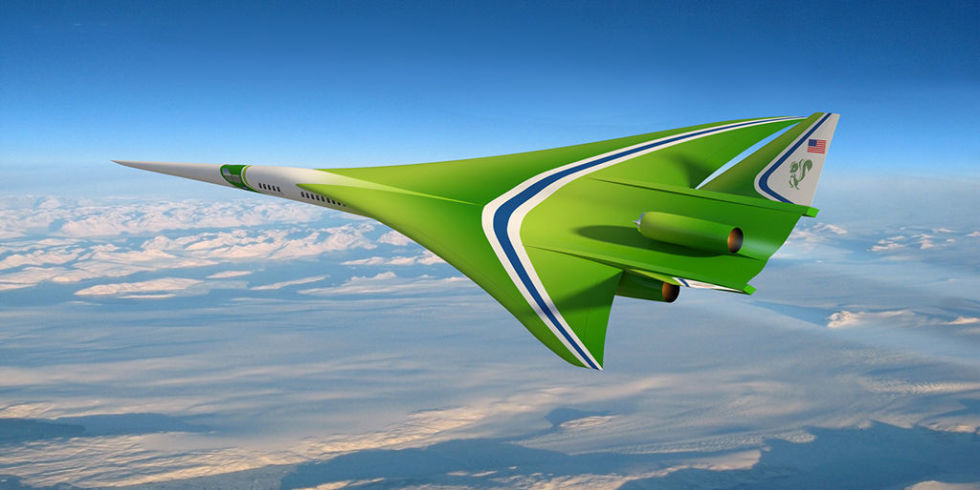
NASA and Lockheed Martin are designing an experimental X-plane called the Quiet Supersonic Technology
(QueSST) demonstrator aircraft that they hope to fly for the first time
in 2019. The program is intended to solve one of the biggest problems
with commercial supersonic flight: noise, and specifically the noise a
plane makes when it breaks the sound barrier. Even if a company
developed a reliable supersonic passenger aircraft,
regulations would allow that plane to break the sound barrier only over
the ocean, preventing the JFK to LAX flight of your dreams.
Lockheed's design of the QueSST,
the LM1044, is intended to prevent the air pressure waves that build up
on the airframe from coalescing into one large shockwave. Such a design
has the potential to break the sound barrier with a low rumble of small
sonic booms rather than the dramatic clap of a large one.
But
the sonic boom isn't the only noise problem on a supersonic jet. The
engines themselves are incredibly loud—too loud for a commercial
airport, especially as traditional airliners get quieter and the
industry lowers noise limits. The Concorde itself was much louder than
the subsonic jets of the late 1970s, and the aviation industry isn't
willing to accept that kind of racket anymore.


 The XH-17 employed an unusual gas-turbine and rotor-tip combustion combination to provide power to spin the gigantic rotors.