Ετικέτες

Πέμπτη 14 Ιουλίου 2016

Romans set for Carmarthen return


image: http://www.southwales-eveningpost.co.uk/images/localworld/ugc-images/276352/Article/images/29492181/14849790-large.jpg
Roman re-enactment group Comitatus
Comments (0)
The Romans are returning to Carmarthen to put on an exciting cavalry display!
Roman re-enactment group Comitatus will be performing in Carmarthen Park on July 23.
The group will set up a living history camp in the park, but the main entertainment will be the cavalry display.
READ MORE: Historical re-enactment events

The Roman Empire's Secret Weapon Was Whistling Ammo

By


The bullets were used approximately 1,800 years ago and were discovered at Burnswark Hill in southwestern Scotland. What actually happened at Burnswark Hill is up for debate. Some scholars claim that the Romans launched a massive attack at native Scots, others claim it was Roman training post. Regardless, there were a lot of Roman soldiers there.

Τρίτη 12 Ιουλίου 2016

Resurrecting a Sherman – World War II era tank restored through time and talents of local volunteers


By Jeremy P. Amick
For nearly five decades, an M4A3E8 Sherman tank sat abandoned in a field at Camp Crowder, Mo. — a World War II Army base that now serves as a training site for the Missouri National Guard. Exposed to the harsh elements, the once domineering piece of war machinery had become little more than a remnant of faded glory, covered with peeling paint and rust.
But through the dedicated efforts of local companies and organizations, the tank has been restored to its former magnificence and now provides insight into the history of World War II armor and a former battalion within the Missouri National Guard.

Δευτέρα 11 Ιουλίου 2016

Smart and Deadly, Russian Sniper Roza Shanina With 54 Confirmed Kills


Barney Higgins
In the deep silence of the endless Russian pine forest, a small, lonesome figure was walking. It was just a few years before the outbreak of the second world war. She had set out alone, without the permission of her parents, carrying only enough food to keep her on her feet for the long march. She was used to walking. Every day for years she had walked eight miles to and from her school in the little village closest to her home; she knew she could do it. Her self-belief and determined spirit drove her steadily on. She was fourteen years old.
This was Roza Shanina. She walked one hundred and twenty miles all alone, at last reaching a train station. From the station, she took the train to the city of Arkhangelsk, where she enrolled in the city’s college.
Rosa Shanina, Russian Sniper, in 1944 {Wikipedia)
She loved the city. The cinemas, the lights, the people and the bustle were worlds away from the isolation of her early years. She was friendly, quick, talkative and highly intelligent, and so she made many friends. Often, she would return to her college dormitory after the doors had been locked, entering with the help of a rope of tied bedsheets let down by her friends inside.
When tuition fees were introduced she had to find a job to support her studies. The job was at a kindergarten in the city, where she was well liked by the children, the parents, and the other staff. The job came with a little apartment, and for the first time she had a place of her own. She worked during the day and studied at night, and the days were full and happy.
It was in 1943 that she enrolled in the military. Hitler had invaded the Soviet Union in 1941, launching the colossal Operation Barbarossa. By 1943, Roza had lost two brothers to the war, and she would lose a third before the war was over. The city where she lived had suffered air raids. She joined the Central Female Sniper Academy, where she excelled. In April of 1944, she was given command of an all female sniper platoon and was deployed to the front.
Minsk, 2.7.41 Gefangene russische Soldaten
Bundesarchiv picture of Soviet POWs during Barbarossa (Wikipedia)
In the aftermath of the hard-won Soviet victory at the battle of Stalingrad, the Russians launched a series of counter-attacks against the German army. It was during these actions, in early April of 1944, that Roza took a human life for the first time. She was shaken, but her comrades congratulated her. As the months passed she became battle hardened and cold. Seven months after that first kill, her wartime diary recalls her feeling that she had found the true purpose of her life in her actions in battle. She writes that, given the chance to go back, she would not change a thing.
It takes a steady hand and a resolute will to kill at range, and these elite soldiers were indeed resolute. Roza Shanina’s unit screened the advancing infantry. They hunted enemy snipers and picked off enemy officers when committed to open battle.
The Soviet commanders were of a mind to keep the sniper units, including the women of Roza’s command, back from the perils of the front in a pitched battle. Despite this policy, the women went where they were needed, and more than once this meant going into action against direct orders. Roza Shanina was sanctioned for disobeying orders, but her actions in combat and the actions of her unit made the commanders relent from pursuing harsh punishment.
Rosa Shanina in 1944 Photo by A. N. Fridlyanski (Wikipedia)
Roza Shanina in 1944 Photo by A. N. Fridlyanski (Wikipedia)
The women fought in battle after battle. In one action, their position was stormed by the enemy, and they fought hand to hand with bayonets and even shovels, killing many of the enemy and capturing the survivors. In another action, Roza hunted an enemy sniper who was camouflaged in a tree canopy.
When dusk fell, the sky behind his tree was lit by the last light of the setting sun, and she was watching. His sniper’s nest showed up clearly in silhouette against the wide sky. She fired her trademark, two shots in very quick succession, and a body slid silently from the tree and thudded to the ground.
By September of 1944, the Soviet army had crossed into German-controlled East Prussia. The German army, embattled though it was, resisted strongly, and fighting intensified as winter deepened. The Soviets began their full-scale East Prussian Offensive in January of 1945, and the women’s sniper platoon was engaged in heavy fighting. The German army positions held out fiercely against the huge Russian advance.
Soviet Tropps during the East Prussian Offensive (Bundesarchiv. Wikipedia)
Soviet Troops during the East Prussian Offensive (Bundesarchiv. Wikipedia)
The East Prussian Offensive involved more than two million soldiers. The Russians advanced steadily toward the city of Königsberg, and in the freezing winter of 1945 the Germans fought hard for every kilometer of ground. Casualties on both sides were terrible, but always the Germans were pushed back under the pressure from the Soviet army.
Everywhere along the front heavy shelling preceded assaults by tanks, field artillery, and infantry. One by one, the fortified positions still held by the Wehrmacht fell. In villages and towns, ridges, valleys, forests and open plains, vicious fighting took place, and always the Russians crept forward.
The Snipers had been committed to the front of the offensive, and it was at the end of January, after ten months of active service, that the war finally claimed the life of Roza Shanina.
tumblr_n42mdrGugz1rg9mqwo4_500
Under heavy shelling and machine-gun fire, two Russian officers found her broken body slumped over that of a wounded artillery officer. She had been standing over him with her rifle in her hand and she still clutched it with one hand when they found her. A shell had burst right next to her, and she was mortally wounded. Though they tried to save her life, there was little that could be done, and she died the next day, on January 28th, 1945. She was 20 years old.
Roza Shanina was a prolific writer, and her diaries – kept against army regulations – were published many years after the war. They give a profound insight into the determined mentality of this young woman. Before she died, she told a nurse that her only regret was that she had not done more in the war effort. Talented and utterly committed, she gave up everything she had to resist the advance of Fascism against her people. Her story, just one among the stories of the millions who died in the Second World War, resonates to this day.

Κυριακή 10 Ιουλίου 2016

Wrecked German Panther tank found in Ukraine in 27 stunning images. Now is on display at the Technikmuseum Sinsheim

Shared by Chindit (  Lieutenant) 


This German Panther Ausf. A tank was found in a bog near the town of Spola (Ukraine) in ... (date unknown). It still has its original paint and markings. Blown up by own troops next to Tscherkassy now is on display at the Technikmuseum Sinsheim (Germany) nearly unrestored, minor faults in the resotored sections.
As you can see from the pictures, it suffered extremely heavy damage from an internal explosion. Basically the entire left side of the vehicle is missing. The early word is that the museum is going to display it as is, rather than trying to restore it, which I agree is the right thing to do.
The Panther was the best all-round German tank of the war and although conceived as a medium tank, at 45 tons and with frontal armour over 100mm thick, it could easily be rated more highly.
The Panther’s thick, sloping front armour was copied from the Russian T-34 but the main gun was a weapon that far excelled anything the Russians possessed, the high velocity KwK 42 L70, which was capable of penetrating any Allied tank in service when it was first introduced.
You can watch an impressive video too! here!: ww2live.com

Σάββατο 9 Ιουλίου 2016

Cistern of Aetius: A massive ‘slice’ of Roman engineering that is now a stadium in Istanbul


Cistern_Of_Aetius_Roman_field_1Painting of the Basilica Cistern by Robert Walsh.
Touted as the ‘Sunken Garden’ (Çukurbostan) during Ottoman times, and currently known as the Karagümrük stadyumu (or Karagümrük stadium), there is an expansive area in modern-day Istanbul that has a bit of exalted history attached to it. How so? Well, as it turns out, the soccer stadium is actually a spatial ‘development’ that aptly demonstrates the advanced degree of Roman engineering ability. To that end, the site was a full-fledged Eastern Roman (Byzantine) open-air cistern with impressive dimensions of 244 m (801 ft) length, 85 m (279 ft) width and 14 m (46 ft) depth. Better known as the Cistern Of Aetius, in its original state, this massive infrastructural construction could have easily encompassed around four American football fields – within its 224,000 sq ft area!

Παρασκευή 8 Ιουλίου 2016

What We Need for 21st Century Combat?


"The way to build aircraft or anything else worthwhile is to think out quietly every detail, analyze every situation that may possibly occur, and, when you have it all worked out in practical sequence in your mind, raise heaven and earth and never stop until you have produced the thing you have started to make."

XP-56 Black Bullet – The strange looking WWII fighter interceptor that you may not know of


 Ultimately, it was unsuccessful and did not enter series production. source
Ultimately, it was unsuccessful and did not enter series production. source
The XP-56 was essentially a hybrid flying wing to which was added a stubby fuselage to house the pilot and engine.
The Northrop XP-56 Black Bullet was a unique prototype fighter interceptor built by the Northrop Corporation. It was one of the most radical of the experimental aircraft built during World War II. Ultimately, it was unsuccessful and did not enter series production.
The initial idea for the XP-56 was quite radical for 1939. It was to have no horizontal tail, only a small vertical tail, used an experimental engine, and be produced using a novel metal. The aircraft was to be a wing with a small central fuselage added to house the engine and pilot. The hope was that this configuration would have less aerodynamic drag than a conventional airplane.

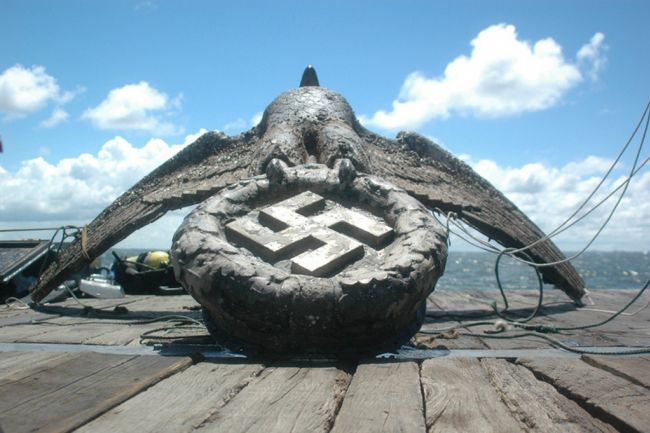
What should Uruguay do with its shipwrecked Nazi eagle?


2014-10-15-nazi-eagle-shipwreck
The huge bronze eagle and swastika, personally designed by Hitler, was salvaged by a British-led team from the stern of the pocket battleship Admiral Graf Spee in 2006. 77 years later, it’s own battle still continues.
War trophies don’t come much more imposing than the solid bronze statue that once adorned the prow of the Graf Spee, a notorious German battleship that sank numerous Allied merchant vessels. When a 700 pound bronze statue of an eagle perched upon a giant swastika sunk onboard German battleship Graf Spee off the coast of Uruguay in 1939, it was thought to be lost forever. Following its recovery from the watery depths by local business man Alfredo Etchegaray in 2006, no one seems quite sure what to do with it.
In December of 1939 the German pocket battleship Admiral Graf Spee fought a relentless battle with an allied task force off the coast of Uruguay. Badly damaged after a ferocious fight, the Admiral Graf Spee was pulled into a Uruguay harbor and scuttled. Seventy-five years later, pieces of the wreckage are in the hands of the Uruguay government and salvagers, prompting a debate about what to do with the Nazi artifacts.
The ship’s captain, Hans Langsdorff, scuttled the damaged vessel offshore outside the capital of Montevideo after the Battle of the River Plate after British intelligence tricked him into believing the Royal Navy was about to surround the ship. It burned for three days before finally sinking; Langsdorff killed himself shortly afterward.

Πέμπτη 7 Ιουλίου 2016

Officials: U.S. Report Will Say Drones Have Only Killed 100 Civilians


The Obama administration is preparing to announce as early as next week that it believes around 100 civilians have died in nearly 500 U.S. drone strikes since 2009, U.S. officials tell NBC News.
That is a far lower estimate than those of the three major independent groups that seek to track the secret operations in the Middle East, South Asia and Africa. The highest estimate among those groups puts civilian casualties from drones at over 1,000.
The disclosure, which is expected to cite an estimated range of civilian deaths lower and higher than 100, represents the latest attempt by the president to fulfill his promises to be more transparent about the controversial secret killing program he ramped up when he took office. Despite those vows, officials continue to release very little information about the targets and circumstances of each lethal strike.
On Assignment: The Drone Revolution 12:05
Obama is expected to issue an executive order requiring annual disclosures of civilians killed in counter-terrorism strikes, officials say, a development first reported by the Daily Beast.
Human rights groups praised the move, but remain skeptical about the numbers.
"This is a big victory," said Naureen Shah, who directs Amnesty International's human rights program in Washington. However, she added, "It's impossible to assess their claims without the administration acknowledging or denying the specific cases that we've put forward."
U.S. officials have credited drone strikes carried out by the CIA and the military's Joint Special Operations Command with putting al Qaeda on its heels. Officials have long said that Hellfire missiles fired from unmanned drones are far more precise than conventional bombing when it comes to targeting terrorists living among civilians.
The disparity in the civilian casualty numbers, however, is likely to fuel the debate about whether U.S. officials can be trusted to grade their own work based on evidence no one else can see.
It is not seriously disputed that U.S. targeted killing operations outside of active war zones have become less frequent and more discriminating in recent years. The main reason for that, officials say, was Obama's decision in 2013 to impose rules that such attacks may only be carried out if there is a "near certainty" that civilians won't be harmed.
The Drone Revolution: Breaking Down the Videos 2:14
The Britain-based Bureau of investigative Journalism, which U.S. officials often privately criticize as biased against the U.S. government, counted one civilian casualty in three Pakistan strikes and none in 13 Yemen strikes so far in 2016.
But when it comes to the overall count since Obama took office, which includes a period from 2009 to 2011 when Obama authorized a flurry of CIA drone strikes in Pakistan, there is a stark disagreement.
The Long War Journal, a project of the right-leaning Foundation for Defense of Democracies think tank whose numbers tend to be the most favorable for U.S. policy-makers, tallied 207 civilian casualties since 2009 in 492 strikes in Pakistan and Yemen. That does not include strikes in Somalia and Libya, which the Obama administration includes in its count of around 100.
New America, a left-leaning Washington think tank, counted between 244 and 294 civilians killed in 547 attacks in Pakistan, Yemen and Somalia.
The Bureau of Investigative Journalism estimates that as many as 1068 civilians were killed in Pakistan, Yemen and Somalia, the vast majority since 2009.
Obama administration officials point out that those groups rely mainly on local media reports, which they argue are often distorted.
For example, current and former officials tell NBC News, Pakistan has on several occasions conducted its own airstrikes against militants and then attributed those attacks to CIA drones. Pakistani media reports based on those leaks then fuel the independent counts.
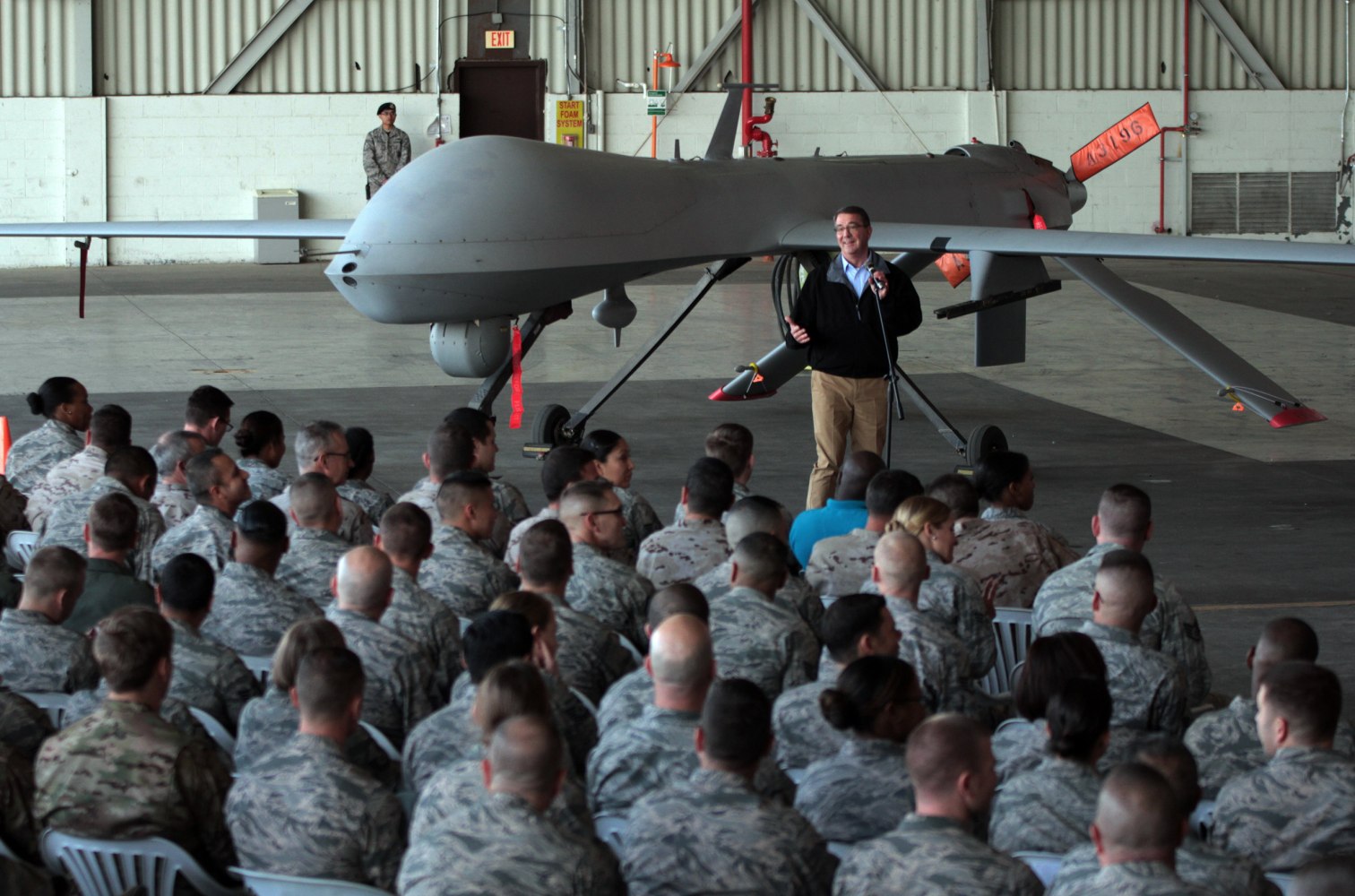
Image: Ash Carter
U. S. Defense Secretary Ash Carter addresses U.S. troops as he stands in front of a drone at the Incirlik Air Base near Adana, Turkey, Tuesday, Dec. 15, 2015. AP
Still, questions have long been raised about how the administration counts military-aged males killed in each strike, and what standard of evidence is used to label someone a militant.
For example, JSOC in 2013 carried out a strike in Yemen that killed 12 people who were deemed militants. But local officials said the strike hit a wedding party, and CIA analysts could not say with confidence that all the dead were combatants.

Τετάρτη 6 Ιουλίου 2016

Under Control: Lockheed Martin-Built MUOS-5 Secure Communications Satellite Responding To Commands

Constellation complete! Following successful launch aboard a United Launch Alliance Atlas 5 rocket, the U.S. Navy's fifth MUOS satellite is in transfer orbit & responding to commands. This satellite is the latest addition to a new, advanced network of four already orbiting satellites and four relay ground stations, which will revolutionize secure, narrowband, ultra-high frequency (UHF) communications—providing near-global coverage for mobile military forces. Congrats, Space and Naval Warfare Systems Command (SPAWAR), 45th Space Wing and team!

MUOS-5 completes the U.S. Navy’s satellite constellation that will provide a new global military cellular network offering enhanced communications capabilities for…
lmt.co

Τρίτη 5 Ιουλίου 2016

Δευτέρα 4 Ιουλίου 2016

Amazing American Civil War Photos Turned Into Glorious Color


Color photography may not have been widely used until the 1930s but that hasn’t stopped an active group of Redditors from looking to change the past. On the Colorized History Subreddit, Redditors use photo manipulation to add color to historical black and white images. 
Two of the most prolific users, Mads Dahl Madsen and Jordan J. Lloyd (who has since started Dynachrome, a digital image restoration agency), have done United States history a favor by taking a large amount of the Civil War photographs available at the Library of Congress and turning them into realistic and beautiful looking color. 

The Most Iconic Civil War Photos Turned Into Glorious Color


Humans are visual creatures and we tend to visualize things in the way they are presented to us. Therefore, when you look at monochromatic photo of an historic event you are imaging it in  black and white.
We are used to watching historic photos in monochromatic format, that’s why we  are always  filled with an extreme sense of fascination and wonderment whenever we encountered a historical image or video restored with color, especially if that historic image dates to 19th century from a iconic event such as The American Civil War. The photography was not invented until the 1820s,  so the American Civil War was one of the first wars to be photographed.
TIME commissioned Swedish artist Sanna Dullaway to restore and colorize some of the most important pictures shot, in black and white, during the  American Civil War. This is an interesting opportunity to try to reimagine the Civil war in lively and vivid colors.

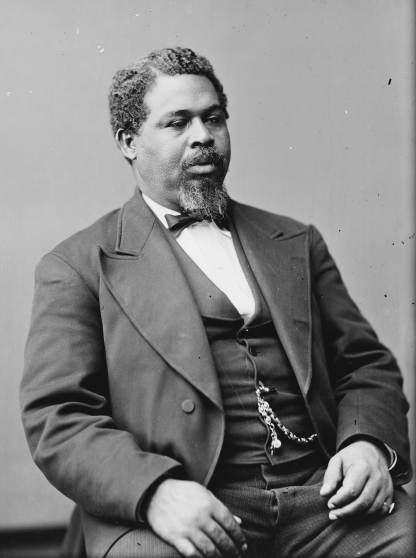
Robert Smalls, S.C. M.C. Born in Beaufort, SC, April 1839 Summary African American legislator.
Robert Smalls, S.C. M.C. Born in Beaufort, SC, April 1839
Summary
African American legislator.

Κυριακή 3 Ιουλίου 2016

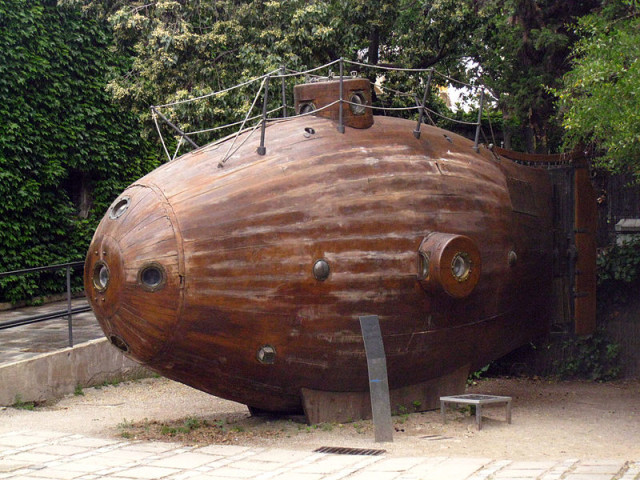
Constructed in Barcelona in 1858, Ictineo I is recognised by many as the world`s first fully functional submarine


Ictineo I was a pioneering submarine constructed in Barcelona, Spain in 1858–1859 by engineer Narcís Monturiol i Estarriol. It was 7 m (23 ft) long with a beam of 2.5 m (8 ft 2 in) and draft of 3.5 m (11 ft). Her intended use was to enable the harvest of coral. It is likely she was inspired by the prototype Brandtaucher of Wilhelm Bauer, completed in 1851, as Monturiol studied all the available science of submersibles. Ictineo’s prow was equipped with a set of tools suited to the harvest of coral. Monturiol had already named his vessel Ictineo, from the ancient Greek icthus (fish) and naus (boat). The vessel had a double hull – a spherical inner shell that resisted the water pressure, and an outer fish-like shell that protected the submarine and was used for steerage and hydrodynamics.
Ictineo I was 7 m (23 ft) long with a beam of 2.5 m (8 ft 2 in) and draft of 3.5 m (11 ft). source
It was 7 m (23 ft) long with a beam of 2.5 m (8 ft 2 in) and draft of 3.5 m (11 ft). source
The pressure hull was constructed from olive wood, supported with oak rings, and covered in 2 mm of copper, and measured 4 metres (13 ft) long, 2 metres (6.6 ft) at its highest, and 1 metre (3.3 ft) wide. Monturiol calculated that it should be able to maintain its integrity to a depth of 500 metres (1,600 ft), although he only rated it to 50 metres (160 ft) for the sake of safety. The outer streamlined hull was 7 metres (23 ft) long, 2.5 metres (8.2 ft) high, and displaced 10 tonnes. Several thick glass ports were installed on the sides, top, and bow of the Ictineo; these were semi-conical in shape so that water pressure would tend to force them more firmly into their seats and so avoid leaks.

Σάββατο 2 Ιουλίου 2016

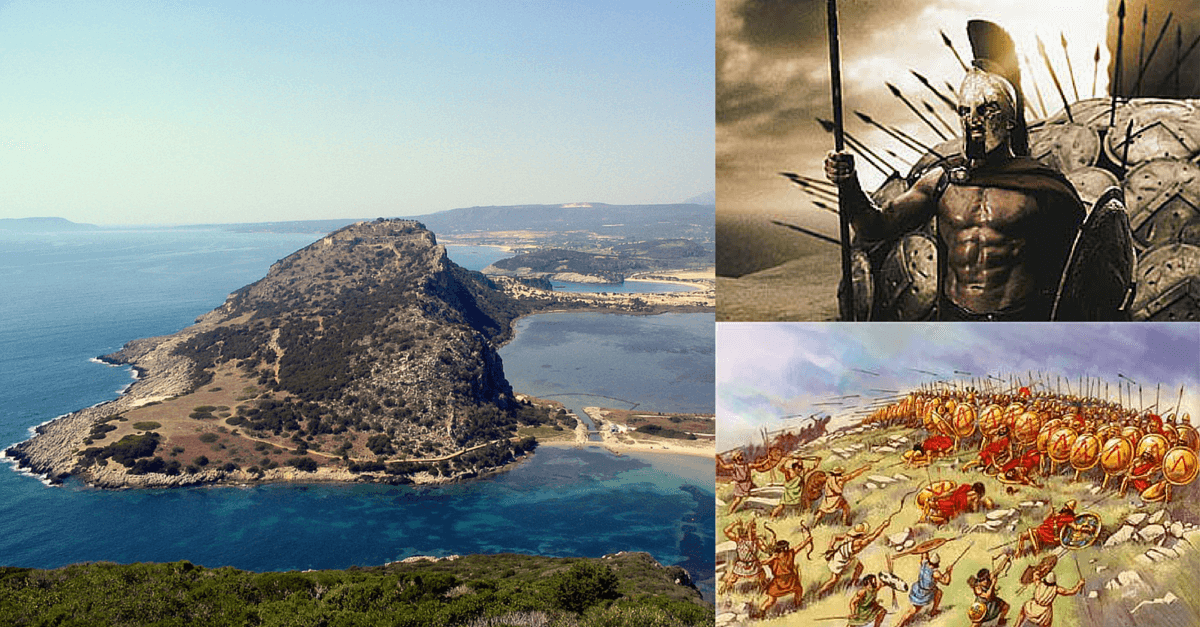
The Spartans Never Surrendered, Until This Battle


388
SHARES
It is often said that the Spartan warriors never retreated and never surrendered. They would fight to the death no matter the odds, and were trained to do so from a young age. However, there’s at least one clear exception.
The titanic struggle that was the Peloponnesian war saw the surrender of the most elite class of Spartans. At the battle of Sphacteria, the Spartans not only lost to a force of mostly light infantry, but they were forced into a shameful surrender that changed the dynamics of the war.
The Peloponnesian War between Athens and Sparta was a long war with multiple swings of momentum and a lot of switching sides. The Spartan strategy was simple: invade the Athenian territory of Attica, destroy farmland, and threaten Athens itself. It should have been a simple and effective tactic considering Sparta’s impressive soldiers. The Athenians had a strategy based off of their imposing navy that sent them all over Greece.

Παρασκευή 1 Ιουλίου 2016

9 Things You Should Know About The Battle of the Somme


One of the most destructive events of the First World War, the Battle of the Somme was a 142-day campaign including a series of smaller battles. To the British, it is symbolic of how World War One was fought.

1. Why Fight at the Somme?

By 1916, there was a stalemate on the Western Front. Both sides were heavily dug in, trench positions providing defenders with the advantage despite the expected offensive power of artillery.
The French were eager to remove the German invaders from their soil. While not as powerfully motivated, the British also wanted a win.
To achieve this, the Allies decided to launch an offensive in the Somme region, where British and French lines met. This would allow both armies to take part.
While they were still planning, the Germans launched an attack on the French at Verdun. This drew French resources into a battle of attrition there, placing the onus upon the British to fight the Somme campaign.
The attack now had an extra purpose – to draw away German resources, relieving pressure on Verdun.

Πέμπτη 30 Ιουνίου 2016

Ο μύθος του Μινώταυρου: Mια αφήγηση για τη σύγκρουση της αγριότητας με τον πολιτισμό…

minot
Η μυθολογία εν γένει και η ελληνική ειδικότερα βρίθουν συμβολισμών και πλούσιων φιλοσοφικών αναζητήσεων πάνω στη ζωή και στην ύπαρξη. Είναι μια αφήγηση που συνδέει την πεζή πραγματικότητα με τη φαντασία, φανερώνοντας όχι απλώς το πολυδιάστατο του ανθρώπινου βίου, αλλά και την εκ βάθρων ανάγκη των έλλογων όντων, να λεκτικοποιήσουν σκέψεις, απόψεις και συναισθήματα. Ίσως αυτό να είναι και το μόνο που μας διαχωρίζει απ’ τα ζώα∙ η φαντασία. Ίσως, πάλι, αυτή η ίδια να μας ξαναενώνει μαζί τους. Ο μύθος του Μινώταυρου, στο σύνολό του, περιλαμβάνει στοιχεία που δεν τα συναντάμε εύκολα σ’ άλλους μύθους. Και μάλιστα, τα στοιχεία αυτά παρέμειναν σταθερά και αναλλοίωτα στο πέρασμα του χρόνου. Ο μύθος του ενέπνευσε την τέχνη διαχρονικά μέχρι σήμερα.

Women and the military draft: Selective Service's fate hinges on the decision


2040 3 LINKEDIN 19 COMMENTMORE
Women could begin registering for the draft as early as 2018, or the entire Selective Service System could be abolished by then.
Both options hang over upcoming negotiations connected to the annual defense authorization bill, since House and Senate drafts of the policy measure contain dramatically different plans on whether women should be required to sign up for possible involuntary military service.

Γκούφι


Χαρακτήρας των κινουμένων σχεδίων από τον κόσμο του Ντίσνεϊ. Ανθρωπόμορφος σκύλος και κολλητός φίλος του Μίκυ Μάους. Ατζαμής, με δόντια αλά Ροναλντίνιο, πλακατζής, έξω καρδιά, ιππότης με τις κυρίες, αθώος σαν παιδί, ολίγον χαοτικός, αλλά πιστός και πάντα έτοιμος να βοηθήσει τους φίλους του.
Ο Γκούφυ (Goofy) γεννήθηκε στα στούντιο της Ντίσνεϊ και εξελίχθηκε ως χαρακτήρας από τον καρτουνίστα Αρτ Μπάμπιτ. Πρωτοεμφανίσθηκε στη μεγάλη οθόνη με το όνομα Ντίπι Ντογκ στις 25 Μαΐου 1932, σε μία ταινία με τον τίτλο «Mickey's Revue». O ρόλος του ήταν μικρός, αλλά το ξεχωριστό γέλιο του δημιούργησε αίσθηση. Ακολούθησαν ρόλοι κομπάρσου σε πέντε ταινίες και στην έβδομη ήρθε η αναγνώριση.

Τετάρτη 29 Ιουνίου 2016

This aging amphib will soon take on ISIS. Here's how sailors and Marines got it ready for the fight


11993 2 LINKEDIN 56 COMMENTMORE
ABOARD THE AMPHIBIOUS ASSAULT SHIP WASP — The Islamic State group is about to feel the sting of this 27-year-old gator as it heads out on its first major deployment in more than a decade.
The amphibious assault Wasp is back in the fight. For the first time in 11 years, the Wasp will deploy to the Middle East with the dock landing ship Whidbey Island and the amphibious transport dock San Antonio. The three ships in the amphibious ready group have a combined age of 68 years.
The ARG will carry more than 2,000 members of the Camp Lejeune, North Carolina-based 22nd Marine Expeditionary Unit, which includes Battalion Landing Team, 1st Battalion, 6th Marines; Combat Logistics Battalion 22; and Marine Medium Tiltrotor Squadron 264 (reinforced).
The sailors and Marines will take up the fight against ISIS during their six-month deployment.
“To think that we are going to go over to that part of the world and not be engaged in some of these fights against ISIS, don't be naïve,” said Capt. Andy Smith, the ship’s commanding officer. “We're going to launch aircraft off with weapons and they're going to come back having dropped them on somebody. If we have to send Marines ashore, they will be in the thick of it.

Γεωργοί από Ελλάδα και Ανατολία έμαθαν την Ευρώπη να καλλιεργεί

Γεωργοί από Ελλάδα και Ανατολία έμαθαν την Ευρώπη να καλλιεργεί
Μετανάστες από τις δύο πλευρές του βορείου Αιγαίου, την Ελλάδα και την Ανατολία (σημερινή Τουρκία), εισήγαγαν τη γεωργία στην Κεντρική και στη Δυτική Ευρώπη, σύμφωνα με μια νέα ευρωπαϊκή επιστημονική έρευνα με επικεφαλής Έλληνες και Γερμανούς επιστήμονες.
Η παλαιογενετική μελέτη βασίσθηκε στην ανάλυση DNA από πέντε σκελετούς που βρέθηκαν σε πρώιμες νεολιθικές τοποθεσίες στη Βόρεια Ελλάδα και στη Βορειοδυτική Τουρκία (περιοχή Θάλασσας Μαρμαρά).

Τρίτη 28 Ιουνίου 2016

B-52s step up airstrikes against Islamic State in Iraq and Syria


B-52 bombers, based in the U.S. Central Command theater for the first time in 26 years, have stepped up strikes against Islamic State militants in the past month.
The bombers flew nearly 140 sorties out of Al Udeid Air Base, Qatar, and employed more than 680 precision weapons against ISIS, Lt. Col. Chris Karns, spokesman for Air Forces Central Command, told Air Force Times on Wednesday.

The road to Brexit: 16 things you need to know about what will happen if we vote to leave the EU


me 2015 (large)
As the referendum on the UK’s membership of the EU draws closer, the result is impossible to predict. Many are asking what, in practical terms, would happen if we vote for Brexit. Alan Renwick explored some key elements of the withdrawal process before the referendum campaign began. Here, he gives a point-by-point overview of what the road to Brexit might look like.
**An updated version of this post was published on 24 June in light of the referendum result**

Μπλεκ: O ήρωας που έδερνε τους Άγγλους και φορούσε γούνινο καπέλο και γιλέκο χειμώνα καλοκαίρι!


Στις 3 Οκτωβρίου του 1954, κυκλοφόρησε για πρώτη φορά ένα κόμικ, με την ονομασία Il Grande Blek Magigno. Ήταν δημιουργία τριών νεαρών σκιτσογράφων της καλλιτεχνικής ομάδας EsseGesse, που την αποτελούσαν οι Ιταλοί Τζον Σινκέτο (1925-1989), Ντάριο Γκουτσόν (1926-2000) και Πιέτρο Σαρτόρι (1926-1989). O Μπλεκ ήταν ο ήρωας του κόμικ, που έδρασε στα τέλη του 18ου αιώνα, στις ΗΠΑ.

Νεαρός, περίπου 25 ετών, ύψος 1.88, μυώδης, που έδερνε αλύπητα τους κακούς Άγγλους αποικιοκράτες ή τους ινδιάνους, για την απελευθέρωση της χώρας του.Οπλισμένος με μαχαίρι, πιστόλι, καραμπίνα αλλά και τις ατσάλινες γροθιές του, σάρωνε όπου μπλεκόταν και έσωζε την πατρίδα του από μια μεγάλη καταστροφή.

Δευτέρα 27 Ιουνίου 2016

Boris Johnson looked sick - because he has no idea how to fix the national disaster he's bequeathed us


Well, Michael Gove was right about the experts being wrong. They totally underestimated the extent of the disaster that Brexit would unleash. It is perhaps why he and his partner in crime Boris Johnson looked like they were at the funeral of their old friend yesterday, not a celebration of one of the most remarkable and truly historic campaign victories of our time.
So let's look at some of the things we on the Remain side said would happen, and which were all dismissed as the scaremongering of Project Fear.

Nazi Germany: The Lippisch P.13a Mach 2.6 range & fuelled by coal


Untitled
As conventional fuels were in extremely short supply by late 1944, Lippisch proposed that the P.13a be powered by coal. Initially, it was proposed that a wire-mesh basket holding coal be mounted behind a nose air intake, protruding slightly into the airflow and ignited by a gas burner.
The last desperate attempts by the Luftwaffe to stop the Allied bomber streams were exemplified by the demand: fighters, fighters, fighters – quick and simple to build, cheap and from easily accessible materials, small dimensions, superior speed compared to enemy escort fighters and firepower. Nearly all aircraft manufacturers and designers in the Third Reich put designs to paper along these lines. Even Dr. Lippisch’s ideas during the last year of the war fit into this concept. Of his numerous variants, the Lippisch 13a was actually given serious consideration.

Referendum fought on ‘democracy’ to see nation get Prime Minister no-one voted for


Boris Johnson to be Prime Minister The country which voted to leave the EU due to a lack of democracy will now be led by a Prime Minister voted for by absolutely nobody.
As David Cameron announced he will stand down before the Conservative conference in October, a new prime minister that none of us chose will now make all the really important decisions that should frighten any normal person.

The preliminary bombardment began for the battle of the Somme.


100 years ago the preliminary bombardment began for the battle of the Somme. French and British artillery would continue firing for 7 days, hoping to break through the German defenses and shatter their morale.

With over 1.5 million shells fired the expectation was that their would be no opposition when the men marched across No Man's Land on 1 July, but the Germans were able to hold their position in dug-outs and the barbed wire remained largely intact.
www.osprey.com,

Κυριακή 26 Ιουνίου 2016

After the Battle of Shiloh Some Civil War Soldiers Actually Glowed in the Dark!


There are many remarkable stories of the American Civil War. One of the most striking, however, is the story of the soldiers who glowed in the dark. By the spring of 1862, it was clear that the Civil War was going to be bloody and long . Major General Ulysses S. Grant had pushed deep into the Confederate-led South along the Tennessee River. That April, he camped at Pittsburgh Landing near Shiloh, Tennessee, waiting for the arrival of Major General Don Carlos Buell and his army.